Soft Wash vs Pressure Washing Roof Damage in Lynnwood, WA
If you're weighing soft wash against pressure washing for a moss-covered roof in Lynnwood, the short answer is this: pressure washing carries substantially higher risk of shingle damage, and for asphalt roofs in the Pacific Northwest, soft washing is the method almost every manufacturer and roofing pro recommends. High-pressure water strips granules, lifts shingle edges, and forces moisture under the roof deck. Soft washing uses low pressure and a cleaning solution to kill moss and algae at the root without mechanical force.
That's the headline. The details matter, though — especially in a climate like ours, where moss isn't a cosmetic issue but a structural one.
The Core Difference Between Soft Wash and Pressure Washing
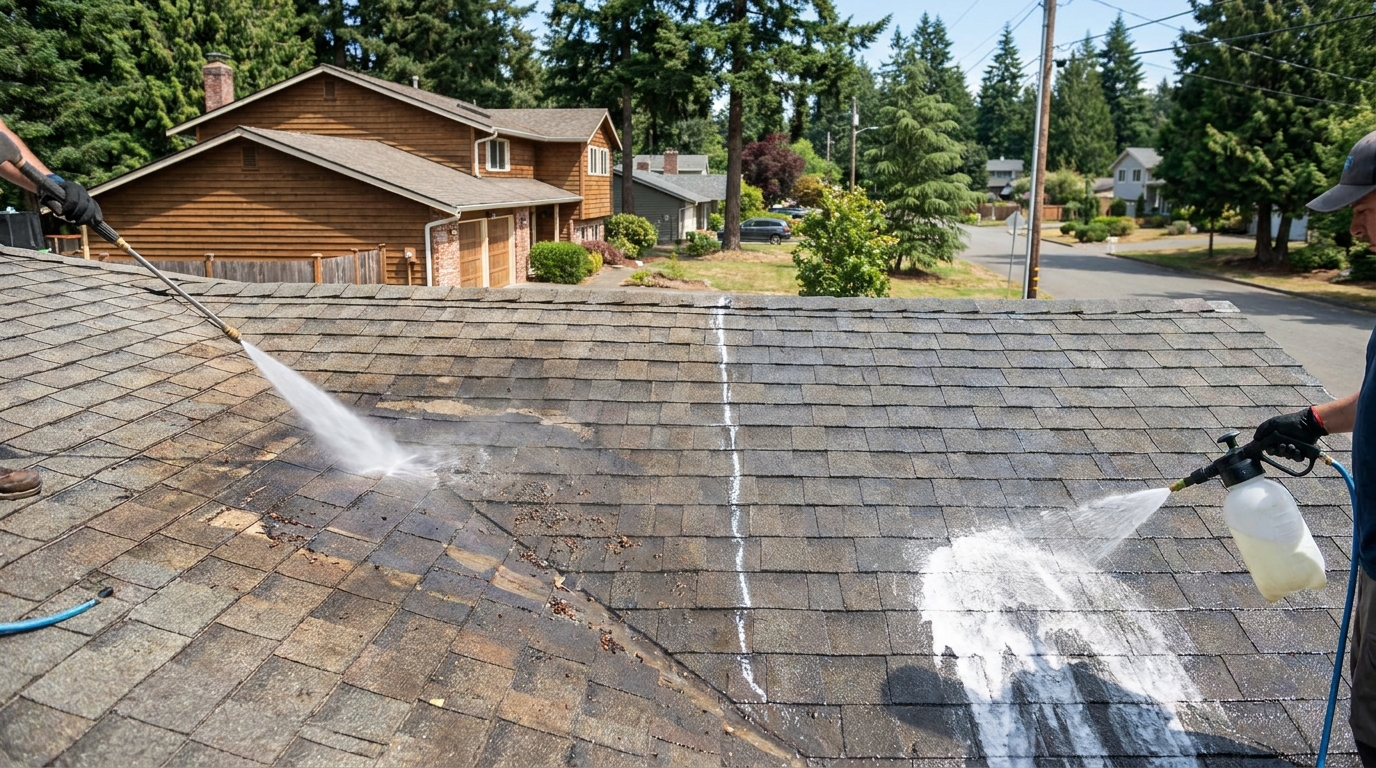
Soft washing uses low-pressure water — typically under 500 PSI, closer to a garden hose — combined with a biodegradable cleaning solution that kills moss, algae, lichen, and mildew. The chemistry does the work; the water just rinses.
Pressure washing uses mechanical force, often 1,500 to 4,000 PSI, to blast contaminants off a surface. It's effective on concrete and some hardscapes. On a roof, that same force is what causes the damage.
The two methods aren't interchangeable. They're built for different substrates, and using the wrong one on asphalt shingles is one of the fastest ways to shorten a roof's life.
Why Pressure Washing Damages Asphalt Shingles
Pressure washing damages roofs through four distinct mechanisms, and all four are common in Lynnwood because most homes here have asphalt composition shingles.
1. Granule Loss
The colored granules on your shingles are the UV shield. They're bonded with asphalt, not glued permanently. A pressure washer at even moderate PSI will blast off years of granule life in a single pass. You'll see them collecting in your gutters and downspouts after the job. Once granules are gone, the asphalt underneath oxidizes fast, and the shingle's rated lifespan drops from decades to a handful of years.
2. Lifted or Cracked Shingles
A pressure wand aimed uphill — which happens constantly on a pitched roof — drives water under the shingle tabs and can lift or crack them outright. Once a shingle is lifted, it's a wind-catch and a leak point.
3. Water Intrusion Under the Deck
Roofs are designed to shed water flowing downward under gravity. They're not designed to resist water driven upward under pressure. Pressure washing routinely forces water past the shingles, past the underlayment seams, and into the sheathing. In our climate, where roofs stay damp for months, that trapped moisture becomes rot.
4. Voided Manufacturer Warranty
Most asphalt shingle manufacturers — including the big names you'll find on Lynnwood roofs — explicitly warn against pressure washing. Doing it can void the remaining warranty. The Asphalt Roofing Manufacturers Association recommends low-pressure chemical cleaning as the standard.
Why Soft Washing Is the Safer Method for Lynnwood Roofs
Soft washing addresses the actual problem in the Pacific Northwest, which isn't dirt — it's biological growth. Moss, algae (particularly Gloeocapsa magma), and lichen thrive in Lynnwood's climate because we get roughly 40+ inches of rain a year, long stretches of overcast damp, and heavy tree canopy in neighborhoods like Alderwood, Martha Lake, and the areas around Scriber Lake. Roofs here rarely fully dry out from October through May.
A soft wash solution kills that growth at the root. Because the moss is dead, it releases its grip on the shingle and washes or brushes away without force. More importantly, treated roofs stay cleaner longer — often two to four years before regrowth becomes visible — because residual biocide continues working.
The tradeoff is that soft washing takes longer and requires trained applicators who understand dwell times, dilution ratios, and how to protect landscaping and siding from runoff. Done poorly, the chemistry can damage plants below the roofline. Done properly, it's the method that keeps your shingles intact.
Risk Comparison at a Glance
| Risk Factor | Pressure Washing | Soft Washing |
|---|---|---|
| Granule loss | High | Minimal |
| Shingle lifting/cracking | High | Low |
| Water intrusion under shingles | High | Low |
| Kills moss at the root | No | Yes |
| Warranty-compliant | Usually no | Usually yes |
| Regrowth timeline | Months | 2-4 years typical |
| Landscape/runoff risk | Low | Moderate (requires care) |
What About Metal, Tile, or Cedar Roofs?
Soft washing is still the recommended method for the vast majority of residential roofs in Lynnwood, including metal, concrete tile, and cedar shake. Cedar in particular is highly vulnerable to pressure damage — the fibers tear, and once torn, they hold more moisture, which accelerates rot in our wet season. Metal roofs can be pressure washed at low settings by an experienced tech, but soft washing still handles the algae and oxidation staining better.
When Pressure Washing Does Make Sense
Pressure washing has a legitimate place — just not on your roof. Driveways, concrete walkways, some fence types, and certain hardscape surfaces respond well to higher pressure. A reputable roof cleaning company in Lynnwood will use pressure washing for those surfaces and soft washing for the roof itself. If a contractor proposes pressure washing your asphalt shingles, that's a signal to get a second opinion.
Timing Your Roof Cleaning in Lynnwood
The two best windows for roof cleaning here are late spring (May-June), after the wet season winds down, and early fall (September-October), before the sustained rains return. Cleaning before winter is particularly valuable because a moss-free roof sheds water properly through the wet months, reducing the risk of ice-dam moisture backup during the cold snaps we occasionally get in January and February.
How to Choose a Roof Cleaning Company in Lynnwood
The criteria that actually matter for protecting your roof:
- Method transparency. The company should tell you upfront whether they soft wash or pressure wash your roof, and why.
- Licensing and insurance. Roof work in Washington requires a licensed, bonded, and insured contractor. Verify before hiring.
- Detailed written estimate. A vague quote is a red flag. You want scope, method, chemistry, and cleanup terms in writing.
- Landscape protection plan. Ask how they'll protect plants and hardscape from runoff.
- Local track record. Companies that work in Lynnwood, Edmonds, Mill Creek, and surrounding Snohomish County communities understand the moss loads and roof types here.
Velocity Cleaning Systems is one of the local providers homeowners in the area work with for this kind of soft-wash roof cleaning. Their 4.8-star Google rating reflects the traits worth prioritizing — one recent client noted the company gave them “a very detailed description of the work to be performed on our roof and driveway,” which is the kind of transparency that separates careful roof work from a rushed job.
FAQ
Does pressure washing damage roofs in Lynnwood?
Yes, in nearly all cases involving asphalt shingle roofs. Pressure washing strips protective granules, can lift or crack shingles, and drives water beneath the roof surface. On Lynnwood's asphalt roofs — the dominant roof type in the area — soft washing is the safer method.
How often should a Lynnwood roof be cleaned?
Most roofs here benefit from a professional soft wash every 2 to 4 years, depending on tree cover and sun exposure. Homes under heavy fir or cedar canopy in neighborhoods like Martha Lake often need cleaning on the shorter end of that range.
Will soft washing kill my plants?
Not if the applicator protects the landscape properly. Pre-wetting plants, tarping sensitive areas, and rinsing afterward are standard steps a trained soft-wash technician takes.
Can I soft wash my own roof?
You can, but the two big risks are chemistry (wrong dilution damages shingles or landscaping) and fall safety. Lynnwood roofs are often steep-pitch and wet-slick with moss — most homeowners are better served hiring a licensed professional.
Does soft washing remove moss immediately?
The solution kills moss on contact, but visible moss often takes several weeks of rain and wind to fully release and wash away. A quality service will remove the bulk of it during the visit and treat what's left so it detaches naturally.
The Bottom Line
For asphalt-shingle roofs in Lynnwood, pressure washing carries meaningfully higher damage risk than soft washing across every metric that matters — granule retention, shingle integrity, water intrusion, and warranty compliance. Soft washing addresses the actual enemy here, which is biological growth fueled by our wet climate, and it does so without mechanical force. Homeowners in Lynnwood, WA who want this handled professionally can reach Velocity Cleaning Systems at https://velocitycleaningsystems.com/ for a free estimate and a written scope of work before any water hits the roof.