Soft Wash vs Pressure Washing: Which Does Your Home Actually Need?
Your roof is turning green. Your driveway looks tired. Your siding has that dingy film that shows up every Kirkland winter after months of rain, shade, and Douglas fir debris. So you start Googling — and immediately run into two competing methods: soft washing and pressure washing. They sound similar. They are not.
Choosing the wrong one can shorten the life of your roof, strip paint off your siding, or waste money on a cleaning that grows back in a few months. Here's how to decide which method your home actually needs — and where the line falls in a wet, moss-friendly climate like ours.
The Core Difference Between Soft Wash and Pressure Washing for Homes
The simplest way to think about it:
- Pressure washing uses high-pressure water — typically 1,300 to 4,600+ PSI — to mechanically blast dirt, mud, and debris off hard surfaces.
- Soft washing uses low pressure — usually 60 to 100 PSI at the pump — combined with sodium hypochlorite and surfactants to kill and dissolve organic growth like moss, algae, and mildew.
Pressure washing is a physical force. Soft washing is a chemical process. One removes. The other kills, then rinses. That distinction matters more in Kirkland than in drier parts of the country, because the vast majority of what darkens roofs and siding here isn't dirt — it's alive.
Why Kirkland's Climate Changes the Answer
Homes across Kirkland — from Juanita and Totem Lake to Rose Hill, Bridle Trails, and the older neighborhoods near Downtown and Market Street — sit in a marine climate with long wet seasons, heavy tree cover, and mild temperatures. That's a perfect greenhouse for:
- Moss on composite and cedar-shake roofs
- Algae streaks (that black "dirt" on north-facing shingles is almost always Gloeocapsa magma)
- Mildew on vinyl siding, stucco, and painted trim
- Slick green film on concrete walkways and pavers
Blasting moss off an asphalt shingle roof with a pressure washer removes the visible growth — and takes a lot of the granular surface with it. The roots stay. The regrowth comes back fast. That's why, for most Kirkland roofs and siding, soft washing is the recommended approach.
Soft Wash Roof Cleaning: When Low Pressure Wins
Soft wash roof cleaning is explicitly the safer, longer-lasting method for residential roofs in this climate. The chemistry does the work — sodium hypochlorite kills algae, moss, and lichen at the root — and the low pressure means shingles, sealants, and flashings aren't disturbed.
Pressure washing, by contrast, can destroy shingle roofs. High-PSI water can lift shingles, strip protective granules, force water under laps, and compromise seals. That's not a rare failure mode — it's the predictable outcome of using the wrong tool.
Soft washing is the right call for:
- Asphalt and composite shingle roofs
- Cedar shakes
- Vinyl and painted wood siding
- Stucco
- Brick with algae or mildew staining
Because soft washing kills the organisms rather than just knocking them off, the intervals between cleanings are longer. For a shaded Kirkland home under tall evergreens, that's real money over a decade.
Pressure Washing Siding, Driveways, and Hardscapes
Pressure washing still earns its keep — just not everywhere. It's the workhorse for hard surfaces where mechanical removal of dirt, tire marks, and heavy debris is the goal:
- Concrete driveways and sidewalks (typically cleaned around 2,500–3,500 PSI)
- Paver patios and walkways
- Some brick and masonry
- Decks (with correct nozzle and distance)
- Surface prep before painting or staining
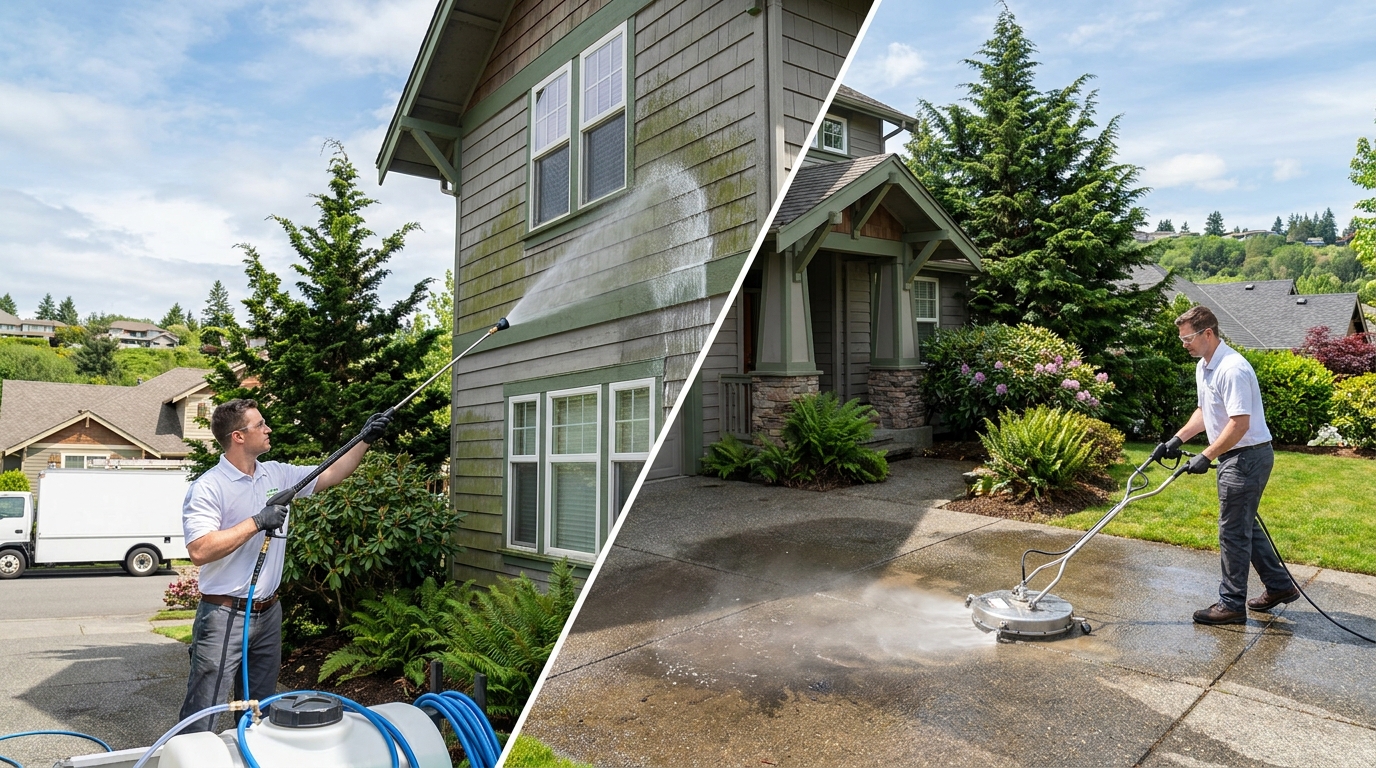
Pressure washing siding is a nuanced case. On sturdy vinyl in good condition, moderate pressure with the right nozzle and distance can work — but on older paint, aging caulk, or wood siding, it's easy to force water behind the cladding or blow out failing seals. For most Kirkland homes, low pressure house washing using soft-wash chemistry is the more conservative, longer-lasting choice for siding, and pressure washing is saved for the hardscape.
When to Use Soft Wash vs Pressure Wash: A Quick Decision Guide
Use this as a shortcut when you're staring at your house trying to figure out which is which:
- Roof (any type): Soft wash. Always.
- Vinyl or painted siding: Soft wash / low pressure house washing.
- Stucco or brick with algae: Soft wash.
- Concrete driveway or sidewalk: Pressure wash.
- Paver patio: Pressure wash (then re-sand joints).
- Wood deck: Depends on condition — often a low-pressure clean with appropriate detergent.
- Fences: Usually soft wash, especially cedar.
The rule of thumb: if the problem is alive, soft wash. If the problem is ground in, pressure wash.
Cost, Longevity, and What to Expect
Straight pressure washing of hardscapes is generally the more economical service. Nationwide, typical project costs run roughly $212 to $448, with an average around $311. Consumer pressure washers themselves run $75 to $300+, and daily rentals fall in the $40–$100 range — which is why plenty of homeowners tackle their own driveways.
Soft washing carries a premium. It requires dedicated 12V soft-wash pumps and tanks (or a pressure washer with downstream chemical injection and specialty tips), controlled chemistry, and trained application to protect landscaping. The tradeoff is longevity — because you're killing organic growth rather than blasting it off, results last measurably longer on roofs and shaded siding.
Kirkland-specific pricing isn't published in standardized tables. Expect site-specific quotes based on roof pitch, story count, tree cover, and how much moss you've been ignoring.
Exterior Cleaning Methods in Kirkland: What to Ask a Pro
Whether you hire Velocity Cleaning Systems or evaluate other providers, the questions worth asking are the same:
- Which method are you using on each surface, and why? A pro should default to soft washing your roof and siding, and pressure washing your hardscapes.
- How do you protect landscaping? Sodium hypochlorite can damage plants if misapplied. Pre-wetting, tarping, and rinse-down protocols matter.
- What PSI and nozzle are you using on concrete? 2,500–3,500 PSI with an appropriate tip is standard.
- What's your guarantee? There's no industry-standard warranty — terms are contractor-specific. Get it in writing.
Kirkland's tree canopy and long wet season mean most homes benefit from a scheduled cadence — roof soft washes every few years, hardscape pressure washing more often, ideally timed after the heaviest debris drop in late fall or before hosting season in spring.
FAQ: Soft Wash vs Pressure Washing
Is soft washing safe for asphalt shingle roofs?
Yes. At 60–100 PSI with proper sodium hypochlorite chemistry, soft washing is the recommended method for asphalt and composite shingles. Pressure washing shingle roofs can damage them.
Can I pressure wash my own driveway?
For a straightforward concrete driveway with no delicate seals or coatings, a consumer or rented unit at around 2,500–3,500 PSI can work. Wear eye protection and keep the wand moving.
How long do soft-wash results last in Kirkland?
Longer than pressure washing on the same organic-contaminated surface, because the growth is killed rather than blasted off. Exact intervals depend on tree cover and roof orientation.
Does soft washing kill plants?
It can, if applied carelessly. A trained applicator pre-wets, tarps, and rinses landscaping to protect it.
The Bottom Line
For most Kirkland homes, the honest answer isn't "one or the other" — it's both, on the right surfaces. Soft wash the roof and siding. Pressure wash the driveway and patio. Skip the method that damages what it's supposed to clean.
Homeowners in Kirkland, WA who want this handled professionally can reach Velocity Cleaning Systems at https://velocitycleaningsystems.com/ for a free estimate and a walk-through of which method fits which surface on your home.