How to Clean Algae Off House Exterior Safely: A Pacific Northwest Guide
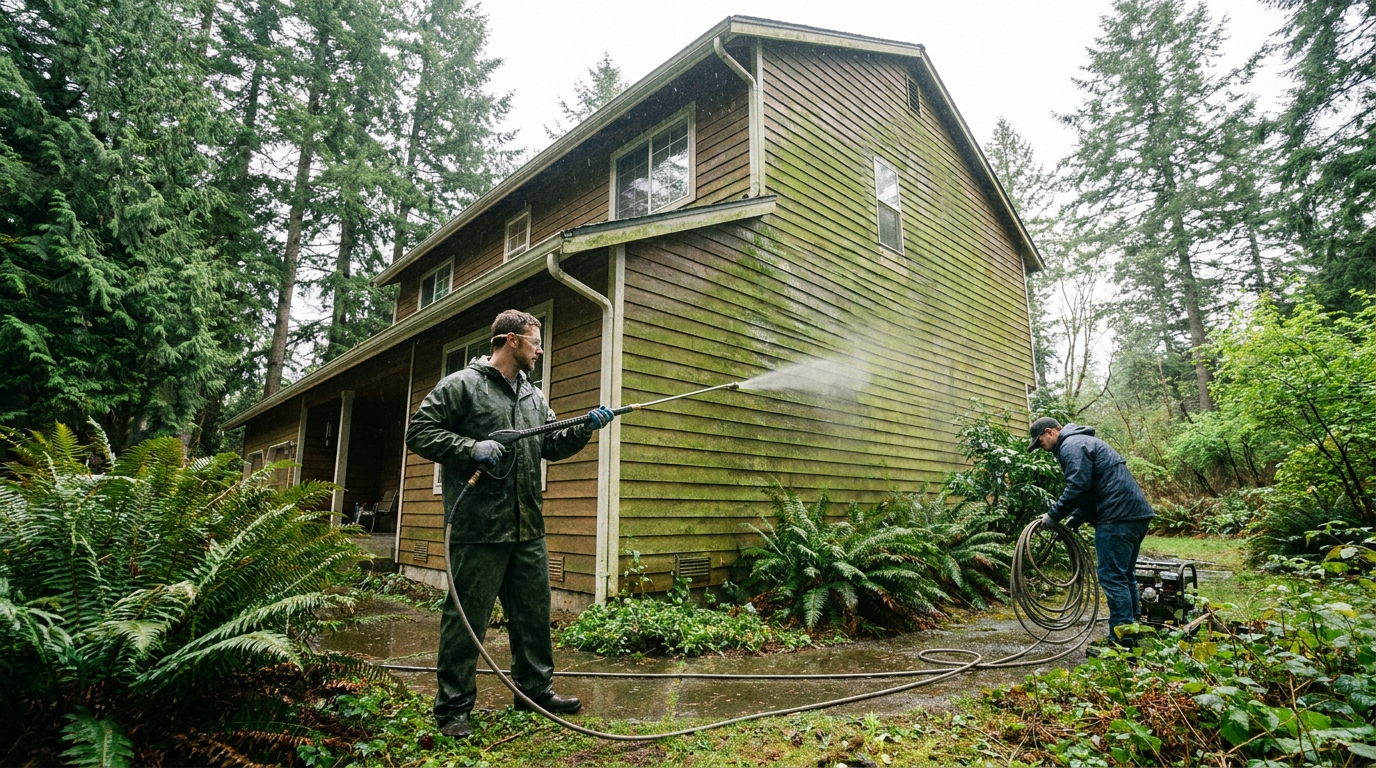
That green, black, or sometimes pinkish film creeping across your siding isn't just cosmetic. It's living organic growth — algae, often paired with mildew and lichen — and in Everett's damp marine climate, it spreads fast and stains deep.
If you're trying to figure out how to clean algae off your house exterior without damaging the siding or pushing water behind it, the method matters more than the muscle. Here's what actually works, what to avoid, and when the job calls for a professional.
Why Algae Thrives on Everett, WA Homes
Everett sits in one of the wettest stretches of the Puget Sound region. Persistent overcast skies, mild temperatures year-round, and humidity rolling in off Possession Sound create ideal conditions for algae growth.
Homes in shaded neighborhoods like Pinehurst-Beverly Park, View Ridge-Madison, and the tree-canopied streets near Forest Park rarely get enough direct sun to dry out fully. North-facing walls suffer the worst. Cedar siding, fiber cement, vinyl, and stucco all collect algae spores, especially on surfaces that stay damp from October through May.
The result: those telltale green streaks, black spotting near gutters, and chalky stains under eaves.
What Algae Actually Does to Your Siding
Algae isn't just ugly. Left untreated, it:
- Holds moisture against your siding, accelerating rot in wood and trim
- Etches and discolors painted surfaces, shortening paint life
- Creates a foothold for mildew, moss, and lichen — which are far harder to remove
- Voids some manufacturer warranties on fiber cement and vinyl if growth isn't addressed
A clean exterior can keep your paint and siding looking up to 10 years newer and extend coating life significantly. Skipping the cleaning, in this climate, is the expensive choice.
The Right Way to Remove Algae From House Siding
The single most important rule: do not blast algae off your house with high-pressure water. This is the mistake we see most often in Everett, and it causes real damage.
High pressure on siding forces water behind lap joints, under trim, and into wall cavities. On older homes near Bayside or Riverside, that can mean soaked insulation and hidden mold within weeks. On vinyl, high pressure cracks panels. On cedar, it gouges the grain.
The correct method is soft washing — applying a low-pressure cleaning solution that kills the algae at the root, then gently rinsing.
Step 1: Inspect and Prep
Walk the perimeter. Note cracked caulk, loose siding, exposed wood, and any open electrical fixtures. Cover landscaping with tarps or pre-wet plants thoroughly so cleaning solution rinses off rather than soaks in.
Close all windows. Disconnect or cover exterior outlets.
Step 2: Mix a Proper Cleaning Solution
For most algae stains, a diluted sodium hypochlorite (household bleach) solution with a surfactant works. A typical mix for siding is roughly 1 part bleach to 4 parts water, plus a few ounces of a cleaning surfactant per gallon to help it cling.
Skip the off-the-shelf "siding cleaners" that rely on scrubbing alone — they treat the symptom, not the organism.
Step 3: Apply Low and Slow
Use a pump sprayer or a downstream injector on a pressure washer set to low pressure (under 500 PSI at the surface). Start at the bottom and work up to prevent streaking. Let the solution dwell for 10 to 15 minutes. You'll watch the green disappear before you ever touch it with water.
Step 4: Rinse Thoroughly
Rinse from the top down with a wide fan tip at low pressure. Take your time around windows, vents, and light fixtures. Rinse landscaping again afterward.
Algae Removal by Siding Type
Vinyl Siding
Vinyl handles soft washing well, but watch for fade lines if you only clean part of the wall. Do the whole elevation.
Fiber Cement (Hardie Board)
Common on newer Everett builds in areas like Silver Lake and Harbour Pointe. Soft wash only — high pressure strips the factory finish.
Cedar and Wood
Older homes around Rucker Hill and Grand Avenue often have cedar. It needs a gentler solution and careful rinsing. Wood holds bleach longer than vinyl does, so dwell times should be shorter.
Stucco
Porous and prone to holding stains. Often needs a second application. Never use high pressure — it pits the surface permanently.
Local Rules Worth Knowing
Washington has specific stormwater regulations. Wash water containing cleaning chemicals cannot legally enter storm drains under Department of Ecology guidance, and the City of Everett's stormwater code aligns with that standard. For homeowners doing a small DIY job, this usually means keeping runoff on your own landscaped soil where it can filter naturally — not letting it run down the driveway into the street.
Professional pressure washing companies are expected to follow Best Management Practices for wash water capture and disposal. It's worth asking any contractor how they handle this.
When to Call a Professional
You can handle a single-story rambler with accessible walls on a dry Saturday. Where it gets complicated:
- Two-story homes or steep lots where ladder work is risky
- Heavy lichen or moss, which requires specialized treatment
- Cedar shake siding, which is unforgiving of mistakes
- Homes with cedar shake or composite roofing nearby (overspray matters)
- HOA neighborhoods like Mill Creek-adjacent communities where wash water containment is scrutinized
At Velocity Cleaning Systems, we use calibrated soft-wash systems, biodegradable surfactants, and wash-water practices designed for Western Washington's stormwater rules. The goal isn't just removing the green — it's killing the algae at the spore level so it doesn't return in six months.
How Often Should You Clean Algae Off Your Home Exterior?
In Everett's climate, most homes benefit from a soft wash every 18 to 24 months. Heavily shaded properties — especially near mature evergreens — may need annual treatment. Sunnier southern exposures can sometimes stretch to three years.
The best window for cleaning is late spring through early fall, when surfaces dry quickly and you're not fighting daily rain.
FAQ: Cleaning Algae Off Home Exteriors
Will bleach kill plants around my house?
Concentrated bleach can. Diluted soft-wash solution, properly rinsed and applied with pre-wetted landscaping, generally won't harm established plants. Care matters more than the chemical itself.
Can I use a pressure washer on vinyl siding?
You can use a pressure washer, but only at low pressure with a wide fan tip — and the cleaning is really done by the solution, not the water. High-PSI blasting damages vinyl and forces water behind panels.
Why does the algae keep coming back?
Because surface scrubbing doesn't kill the organism. Without a proper biocide application, spores remain and regrow within months. This is the most common reason DIY cleanings disappoint.
Are algae stains permanent?
Most aren't, if treated before they've etched the surface. Long-standing black streaks on painted wood or chalky stucco can leave faint shadows even after proper cleaning.
Is soft washing safe for painted siding?
Yes — that's the point of soft washing. Low pressure preserves paint while the cleaning solution does the work.
The Bottom Line
Algae on your house exterior is a solvable problem, but only with the right method. High pressure damages siding. Surface scrubbing doesn't kill the growth. The combination of a properly mixed cleaning solution, low-pressure application, and careful rinsing is what actually works — and it's what protects your siding investment over the long run.
Homeowners in Everett, WA who'd rather have this handled professionally can reach Velocity Cleaning Systems at https://velocitycleaningsystems.com/ for a free estimate. We'll assess your siding, climate exposure, and growth severity, and recommend the right approach for your home.