Soft Wash vs Pressure Washing for Roofs in Kirkland: Which Method Actually Works?
If you've spent a Kirkland winter watching moss creep across your asphalt shingles, you've probably asked the same question every homeowner here eventually asks: what's the best way to clean a roof without damaging it? And does roof cleaning damage shingles in the first place?
The short answer: the cleaning method matters more than the cleaner. In Kirkland's wet, marine-influenced climate, soft washing has become the default recommendation for residential roofs, while traditional high-pressure washing is increasingly viewed as a last resort — or a method better suited to driveways and patios. Here's how the two approaches actually compare, and what that means if you're searching for roof cleaning near me in the Eastside.
What Soft Washing and Pressure Washing Actually Do
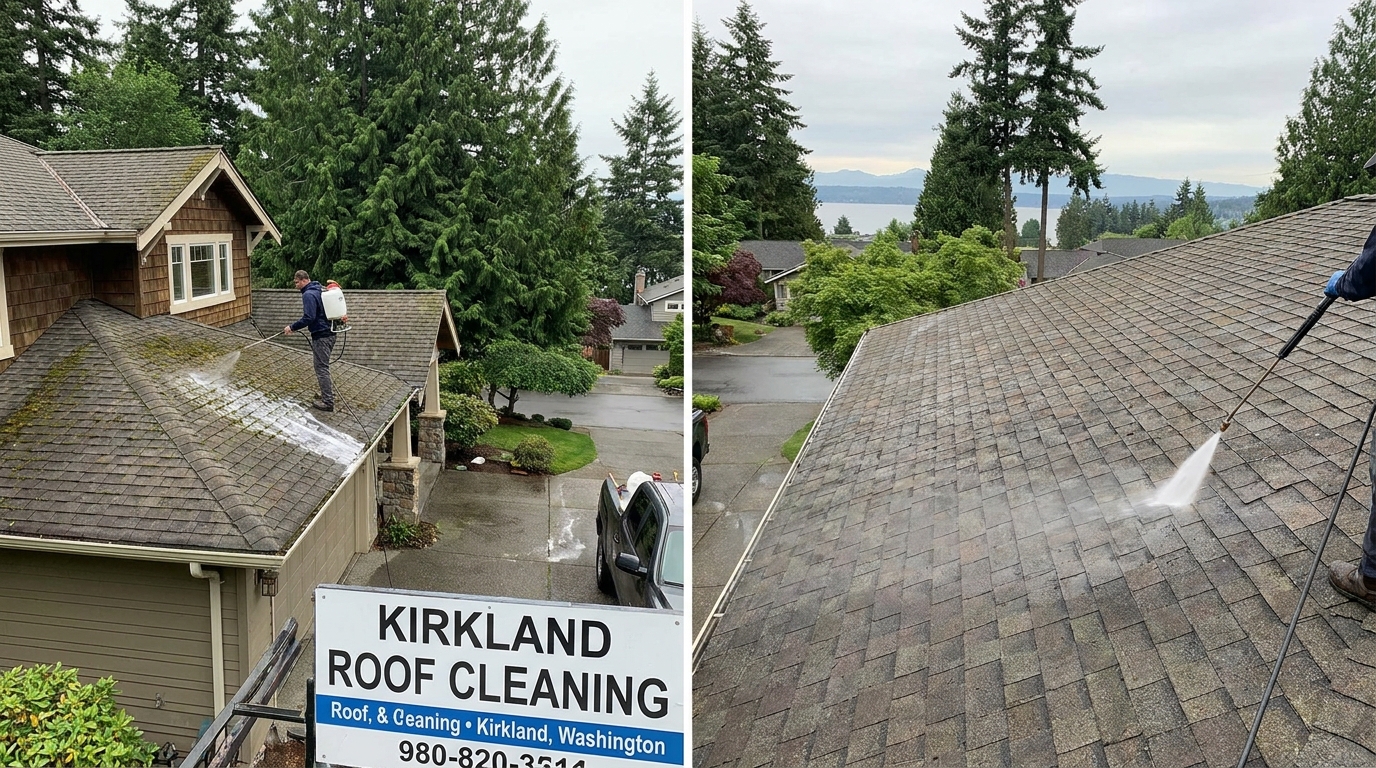
Soft wash roof cleaning uses low-pressure equipment — generally 100 PSI or less for roof surfaces, and almost always under about 500 PSI — paired with biodegradable cleaning solutions containing sodium hypochlorite, surfactants, and biocides. The chemistry does the work. The water is mostly there to apply and rinse.
Pressure washing is the opposite philosophy. It uses high-pressure pumps producing 1,300 to 3,100+ PSI, relying almost entirely on mechanical force with little or no detergent. On concrete and brick, that works beautifully. On a roof, it's a different conversation.
Operating Pressure: The Core Difference
The PSI gap between these two methods is enormous. A soft wash setup spraying at under 100 PSI is closer to a heavy garden hose than to a power washer. A pressure washer aimed at the same shingle can deliver 30 times that force.
This is why soft washing carries low risk of physical damage and pressure washing carries high risk. Asphalt shingles are protected by a layer of mineral granules. Those granules are what give shingles their UV resistance and lifespan. High-pressure water strips them — sometimes visibly, sometimes invisibly over the following season — and once they're gone, the shingle's clock starts ticking faster.
Does Roof Cleaning Damage Shingles?
Done correctly, no. Done with the wrong tool, absolutely.
Pressure washing at typical PSI ranges can strip asphalt granules, crack or dislodge tiles, damage sealants and coatings, and create entry points for leaks. Cedar shake — common on older homes in neighborhoods like Market, Norkirk, and parts of Houghton — is even more vulnerable. So is older metal roofing where coatings have started to age.
Soft washing, by contrast, doesn't dislodge granules or stress the underlying material. It's suitable for asphalt shingle, cedar shake, metal, tile, vinyl, stucco, and painted exteriors — essentially the full range of roofing and siding you'll find on a Kirkland street.
Longevity: 4–6 Years vs 6–12 Months
This is where the methods really separate.
Soft washing kills moss, algae, and mold at the cellular and root level. The biocidal solution penetrates the organism rather than just knocking off what's visible. Results typically last 4 to 6 years before another full cleaning is warranted.
Pressure washing removes surface contamination but leaves spores and root systems embedded in the roofing material. In Kirkland's damp climate — where Lake Washington moisture, Pacific Northwest rainfall, and tree canopy create near-perfect moss conditions — regrowth often becomes visible again within 6 to 12 months.
Put differently: in the same 4-to-6-year window where one soft wash holds up, a pressure-washed roof may need four to six repeat visits. That math drives most of the cost discussion.
Upfront Cost in Kirkland, WA
Roof cleaning in Kirkland generally runs between $250 and $800+ per job, depending on roof size, pitch, material, and how much moss has taken hold. Within that range:
- Soft washing sits at the higher end — often $400 to $800+ for medium-to-large roofs with established moss — because it requires specialized low-pressure pumps, chemical solutions, longer application time, and a typical 2–4 hour job window with 10–30 minutes of chemical dwell time.
- Pressure washing tends to land near the lower end of that range because the equipment is simpler and the application is faster.
Pressure washing wins the per-visit cost comparison. But that's the only column where it wins.
Long-Term Cost Effectiveness
Stretch the timeline to four years and the picture flips. One soft wash at $600 versus four or more pressure washes at $300+ each — plus the cumulative wear on the roof itself — and soft washing comes out meaningfully cheaper, with less risk of accelerating roof replacement.
For most Kirkland homeowners, the question isn't really "which is cheaper today." It's "which protects a roof that costs five figures to replace."
What Makes Kirkland Different
A few local factors push the recommendation harder toward soft washing here than in drier markets:
- Marine climate and moss pressure. Kirkland averages substantial annual rainfall, mild temperatures, and heavy tree cover in neighborhoods like Bridle Trails, Rose Hill, and Juanita. Moss, algae, and lichen establish quickly and re-establish even faster when only the surface is removed.
- Housing stock. A large share of Kirkland homes use asphalt composition shingle — exactly the material most vulnerable to granule loss from high-pressure water.
- Manufacturer warranty considerations. Some roofing manufacturers specify acceptable cleaning methods, and pressure washing can void coverage. Homeowners should check their shingle manufacturer's guidelines before any cleaning method is chosen.
- Stormwater rules. Cleaning chemicals that run off into storm drains feeding Lake Washington are a legitimate environmental concern. Reputable providers manage runoff and use roof-safe biodegradable solutions; this is worth asking about directly.
When Pressure Washing Still Makes Sense
Pressure washing isn't bad equipment — it's mis-applied equipment when aimed at a roof. For concrete driveways, paver walkways, brick patios, retaining walls, and stone hardscape around your home, high-pressure water is the right tool. Many Kirkland homeowners use both methods on the same property: soft wash on the roof and siding, pressure wash on the flatwork.
What to Look for in a Kirkland Roof Cleaning Provider
When you're evaluating a roof cleaning company on the Eastside, the criteria that matter most:
- Method transparency. They should clearly state they soft wash residential roofs and explain why.
- Chemistry disclosure. Ask what's in the solution and confirm it's biodegradable and roof-safe.
- Landscape protection. Plants below the roofline need to be rinsed and protected during application.
- Material-specific experience. Cedar shake, composite shingle, and metal each have their own quirks.
- A written scope. Pricing should be tied to roof size, pitch, and moss severity — not a flat phone quote.
Velocity Cleaning Systems is one of the providers serving Kirkland and the broader Eastside that focuses on soft wash methods for residential roofing. The qualities listed above — disclosed chemistry, low-pressure equipment, and material-appropriate technique — are what any homeowner should be screening for, regardless of which company they ultimately hire.
Frequently Asked Questions
Is soft washing safe for older Kirkland homes with cedar shake?
Yes — soft washing is specifically recommended for cedar shake because high-pressure water can splinter and erode the wood. Cellular-level biocide treatment is the standard approach for these roofs.
How often should a Kirkland roof be cleaned?
A properly soft-washed roof typically holds up for 4 to 6 years before another full cleaning is needed. Annual visual inspections — especially after fall leaf drop and before the wettest winter months — help catch buildup early.
Will pressure washing void my roof warranty?
It can. Many asphalt shingle manufacturers specify cleaning method restrictions, and aggressive pressure washing has been flagged as a potential warranty issue. Check your specific manufacturer's guidelines before authorizing any method.
What's the best time of year to clean a roof in Kirkland?
Late spring through early fall, when the roof is dry and temperatures support proper chemical dwell time. Cleaning before the heaviest fall and winter rains helps preserve the treatment.
The Bottom Line
For residential roofs in Kirkland, soft washing is the safer method, the longer-lasting method, and — over any reasonable time horizon — the more economical method. Pressure washing belongs on your driveway, not on your shingles.
Homeowners in Kirkland, WA who want this handled professionally can reach Velocity Cleaning Systems at https://velocitycleaningsystems.com/ for a free estimate and a method recommendation based on your specific roof.