Does Professional Roof Cleaning Damage Shingles? A Fall City Guide
If you've watched moss creep across your roof through another wet Snoqualmie Valley winter, you've probably asked the question every Fall City homeowner eventually asks: does roof cleaning damage shingles? It's a fair concern. Asphalt shingles aren't cheap, and stories about blasted granules and voided warranties travel fast in close-knit communities like ours.
The short answer: professional roof cleaning, done correctly, does not damage shingles. Done incorrectly — typically with high-pressure equipment — it absolutely can. The difference comes down to method, technician training, and matching the cleaning approach to your specific roof type.
Why Fall City Roofs Need Cleaning in the First Place
Fall City sits in one of the dampest microclimates in King County. Tucked between the Snoqualmie River and the foothills, properties here see persistent moisture, heavy tree canopy, and limited direct sunlight on north-facing slopes for much of the year. That combination is a greenhouse for moss, lichen, and the black algae streaks (Gloeocapsa magma) that show up on so many roofs along SE Fish Hatchery Road and out toward Preston.
Left alone, moss doesn't just look bad. Its root-like rhizoids work under shingle edges, lifting them and trapping moisture against the decking below. Lichen is worse — it bonds chemically to the granule surface and feeds on the limestone filler in asphalt shingles. Every season you delay, you lose roof life.
So cleaning isn't cosmetic in this climate. It's maintenance, the same way gutter cleaning is maintenance before the November rains pick up.
The Real Source of Shingle Damage: Pressure Washing
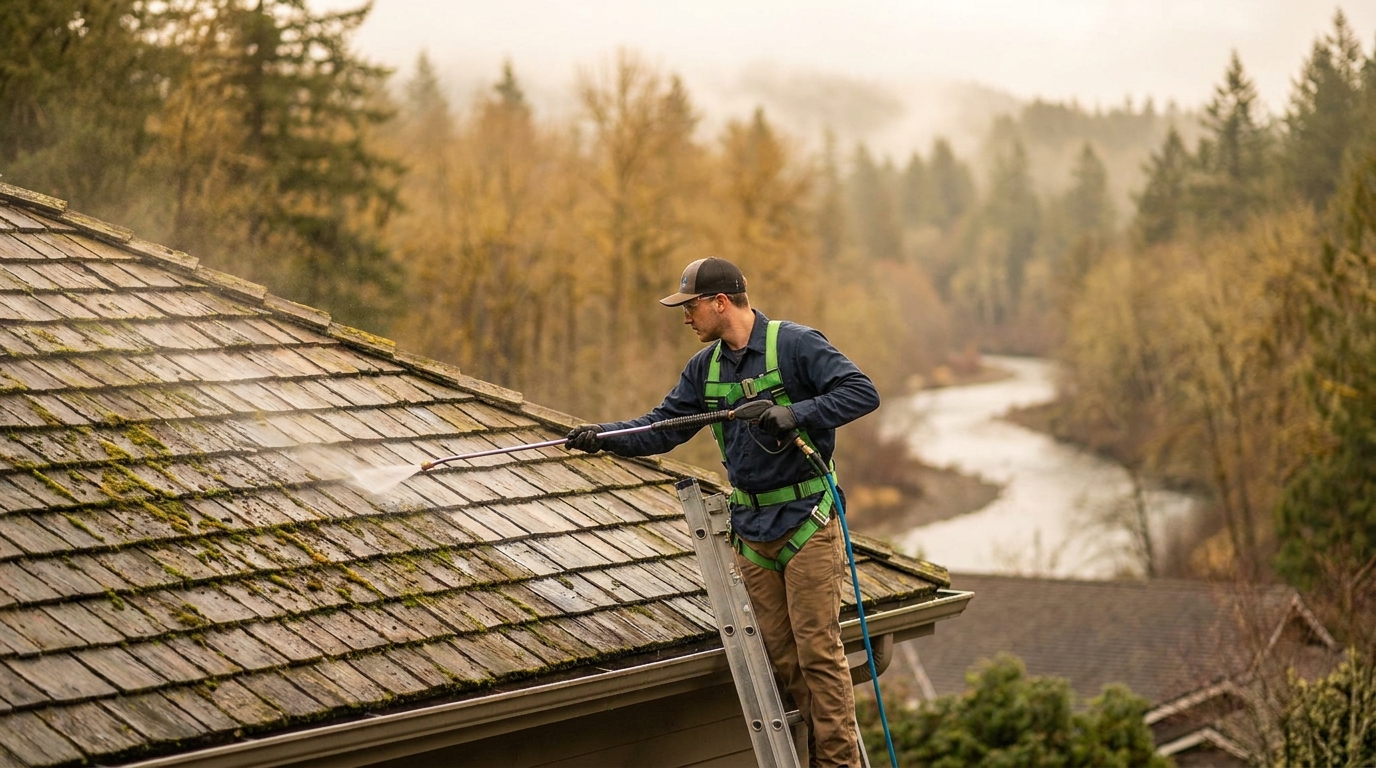
When people say roof cleaning damaged their shingles, they're almost always describing a pressure washing job. High-pressure water — anywhere from 1,500 to 3,000 PSI — does three things to an asphalt roof:
- Strips the protective ceramic-coated granules that shield the asphalt from UV
- Forces water under shingle laps and into the underlayment
- Erodes the asphalt mat itself, shortening roof life by years
Most major shingle manufacturers, including GAF and CertainTeed, explicitly warn against pressure washing in their care guidelines. Some warranties are voided by it. If a contractor shows up in Fall City with a pressure wand and a ladder pointed at your roof, that's your cue to send them home.
Soft Wash vs Pressure Washing for Roofs: What Actually Works
The industry-standard method for asphalt shingles is soft washing. Soft wash systems apply cleaning solution at roughly 60 to 100 PSI — about the pressure of a garden hose — and rely on the chemistry, not force, to kill moss, algae, and lichen at the biological level.
A proper soft wash uses a sodium hypochlorite solution diluted to roof-safe concentrations, often combined with a surfactant to help it cling and penetrate. The organisms die within minutes. Rain and weather then rinse the residue away over the following weeks, with no scrubbing and no granule loss.
Soft washing is what reputable providers like Velocity Cleaning Systems use on asphalt and composite roofs throughout Fall City. It's slower than blasting, requires more chemistry knowledge, and demands proper protection for plants, gutters, and downspouts feeding into local drainage — but it's the only method that cleans without shortening roof life.
When Pressure Is Actually Appropriate
Pressure has its place — just not on shingles. Concrete driveways, paver patios, and some siding materials handle pressure fine. The mistake is treating every exterior surface like it's the same. A trained crew adjusts equipment to the substrate, not the other way around.
Tile Roofs Are a Different Conversation
Fall City has its share of concrete and clay tile roofs, particularly on newer custom homes up toward Lake Alice and the ridges above the valley. Tile cleaning follows different rules.
Concrete tile can tolerate slightly higher pressure than asphalt, but the underlayment beneath is the weak point — and forcing water under tiles is how leaks start. Most professionals still soft wash tile for the biological cleaning, then carefully rinse with controlled low pressure.
Tile roof cleaning cost in the Fall City area generally runs higher than asphalt — often in the range of $0.50 to $1.25 per square foot depending on pitch, access, tile condition, and how much moss has accumulated. Steep pitches and multi-story homes push that range upward because of the rigging and safety equipment required. A typical 2,500-square-foot tile roof might land between $1,200 and $3,000 for a thorough professional cleaning. Asphalt soft washing usually comes in lower.
Get an on-site estimate rather than a phone quote. Tile condition varies enormously, and a credible contractor will want to see the roof before pricing it.
What Safe Professional Roof Cleaning Looks Like
If you're vetting a roof cleaner in Fall City, here's what a safe, shingle-friendly job involves:
- Inspection first. The crew identifies roof type, pitch, condition, problem areas, and any loose flashing or damaged shingles before any chemistry touches the roof.
- Plant and property protection. Landscaping gets pre-wetted or tarped. Gutters and downspouts are accounted for since runoff in Fall City eventually reaches the Snoqualmie watershed.
- Soft wash application. Roof-safe solution applied at low pressure, with dwell time appropriate to the organism being treated.
- Controlled rinse, if needed. No pressure washing — gentle rinsing only where the situation calls for it.
- Walk-through and documentation. Before-and-after photos, notes on any damage spotted during work, and recommendations for follow-up.
L&I contractor registration in Washington is non-negotiable. Verify it on the state Department of Labor & Industries website before hiring anyone who climbs on your roof. Insurance certificates should be current and provided on request.
Frequently Asked Questions
How often should I have my roof cleaned in Fall City?
Most asphalt roofs in this climate benefit from a soft wash every 3 to 5 years, with annual moss treatments in between for heavily shaded properties. Homes under heavy tree cover near the river may need more frequent attention.
Will roof cleaning void my shingle warranty?
Pressure washing often will. Soft washing performed to manufacturer guidelines generally will not. Keep documentation of the cleaning method used — reputable contractors provide this without being asked.
What's the best time of year to clean a roof in Fall City?
Late spring through early fall is ideal. Dry shingles, warmer temperatures, and longer treatment dwell times all favor results. Scheduling before the heavy October-through-March rains gives you the cleanest entry into the wet season.
Can I just use a moss killer myself?
Granular zinc products can slow regrowth, but they don't remove existing moss or address lichen and algae. DIY pressure washing is the most common way homeowners damage their own roofs — it's the scenario professional cleaners get called to fix.
Does cleaning actually extend roof life?
Yes. Industry estimates suggest moss and algae removal can add 5 to 10 years to a shingle roof's service life, depending on age and condition at the time of cleaning.
The Bottom Line
Professional roof cleaning does not damage shingles when the right method is used. Soft washing is safe, manufacturer-approved, and substantially more effective at killing the organisms responsible for shingle decay than any pressure-based approach. The damage stories you've heard almost always trace back to pressure washing — which is a different service entirely, performed by crews who shouldn't be on a residential roof in the first place.
Homeowners in Fall City, WA who want this handled professionally can reach Velocity Cleaning Systems at https://velocitycleaningsystems.com/ for an on-site assessment and estimate. Bring questions about method, chemistry, and warranty implications — a good contractor will welcome them.