Roof Cleaning Chemical Safety: Professional Handling and Application in Everett
You've looked up at your Everett roof, noticed the dark streaks and moss colonies creeping across the shingles, and started researching solutions. Somewhere between YouTube tutorials and big-box store aisles, you've discovered that roof cleaning involves serious chemicals — sodium hypochlorite, sodium hydroxide, surfactants, and biocides that can transform a moss-covered roof into an immaculate surface in hours.
You've also probably realized something else: these chemicals are not forgiving. Mishandle them, and you can damage your roof, kill your landscaping, harm Puget Sound waterways, or end up in the emergency room.
Here's what professional roof cleaners in Everett actually do to handle chemicals safely — and why the gap between DIY enthusiasm and professional execution is wider than most homeowners realize.
Why Roof Chemical Safety Matters More in the Pacific Northwest
Everett's climate is essentially a moss factory. The Snohomish County corridor sees roughly 37 inches of annual rainfall, persistent overcast skies, and the kind of damp shade conditions that allow gloeocapsa magma, lichen, and moss to colonize asphalt and cedar shake roofs with remarkable efficiency.
That biological pressure means roof cleaning here isn't a luxury — it's maintenance. But it also means the chemicals required to kill established moss colonies are stronger than what you'd need in a drier climate.
Sodium hypochlorite (the active ingredient in soft wash solutions) is typically diluted to 4–6% concentration for roof work. That's roughly the strength of pool shock. Combine it with surfactants and apply it under pressure, and you're working with a substance that can blind you, burn your skin, and decimate the rhododendrons your neighbor in Mukilteo has been growing for fifteen years.
The Real Risks of DIY Roof Cleaning Chemicals
Personal Injury
Sodium hypochlorite vapor causes respiratory damage. Skin contact causes chemical burns. Eye contact can cause permanent corneal damage. Mixing it accidentally with ammonia-based products — something that happens when homeowners try to "boost" their cleaning mix — produces chloramine gas.
Now add a wet, sloped roof. Falls from residential roofs send thousands of Americans to emergency rooms every year, and the L&I requirements that licensed contractors follow for fall protection in Washington State exist precisely because this work is genuinely dangerous.
Property Damage
Wrong concentration burns shingles. Wrong dwell time strips finishes off gutters and siding. Wrong rinse procedure leaves chemical residue that continues degrading materials for weeks.
Cedar shake roofs — common throughout older Everett neighborhoods like Riverside and Bayside — require completely different chemistry than composite shingles. Use the wrong product and you'll permanently grey or splinter the wood.
Environmental Harm
Snohomish County stormwater drains directly into Puget Sound and the Snohomish River system. Runoff laden with sodium hypochlorite kills landscape plants on contact and harms aquatic life downstream. The Washington State Department of Ecology takes this seriously, and homeowners who dump untreated chemical runoff into storm drains can face liability they didn't anticipate.
How Professional Application Differs from DIY Attempts
Soft Wash, Not Pressure Wash
The single most important shift in modern roof cleaning is the soft wash method. High-pressure washing strips granules off asphalt shingles and voids most manufacturer warranties. Professional roof cleaners use low-pressure application (typically under 100 PSI) combined with chemistry that does the actual cleaning work.
The chemicals dwell, kill the biological growth, and get rinsed away. The roof does the cleaning chemically — not mechanically.
Calibrated Mix Ratios
Professionals don't pour chemicals from a jug. They mix to specific ratios calibrated to roof material, biological load, weather conditions, and dwell time. A heavily moss-covered cedar roof in the shaded hills above Silver Lake gets a different formulation than a sun-exposed composite roof in a newer Mill Creek subdivision.
Pre-Treatment Site Protection
Before any chemical touches the roof, professional crews wet down landscaping, tarp sensitive plants, redirect downspouts, and protect water features. This isn't optional — it's the difference between a clean roof and a clean roof surrounded by dead hostas.
Personal Protective Equipment
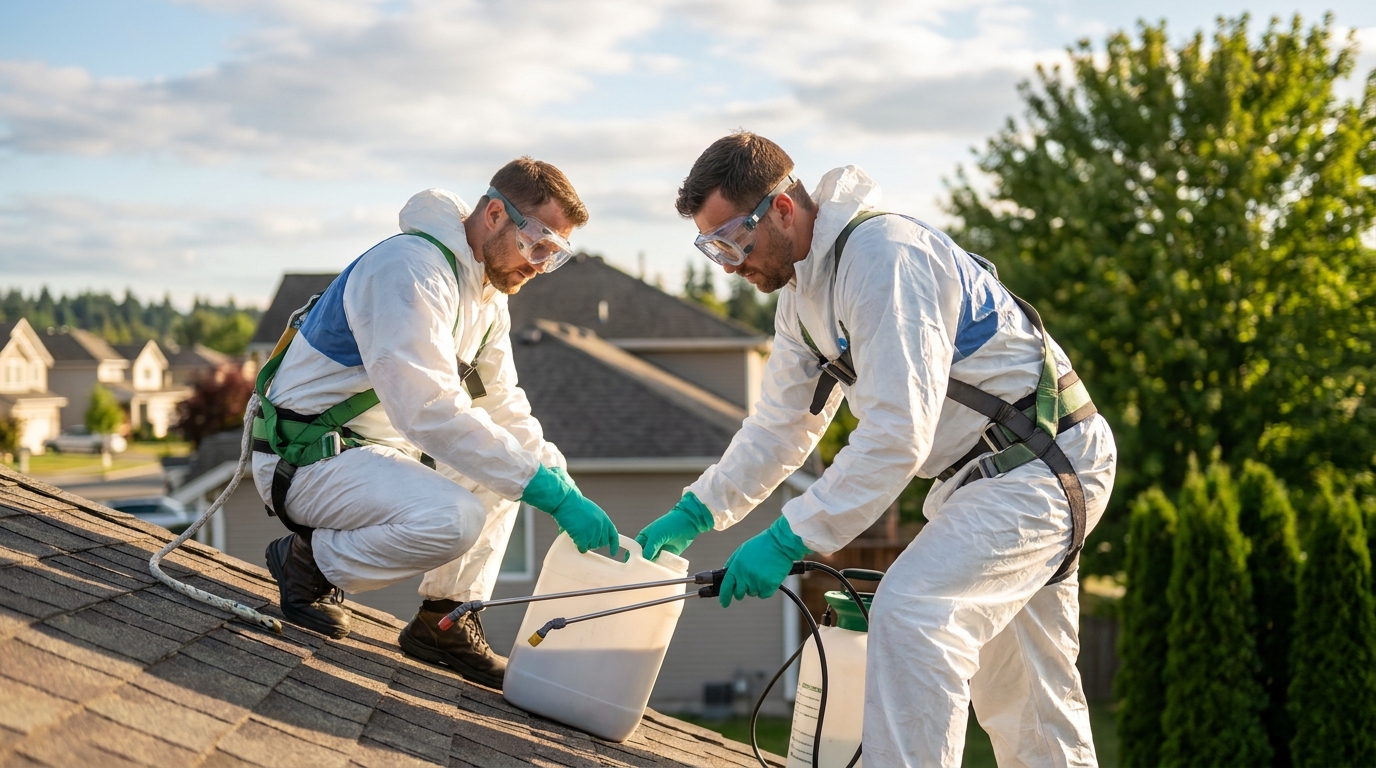
Real PPE for this work means chemical-resistant suits, respirators rated for chlorine vapor, splash goggles, and harness-based fall protection systems anchored to engineered points. The hardware-store dust mask and safety glasses most DIYers wear are not adequate.
What Safe Roof Treatment Looks Like Step by Step
- Inspection — assess roof material, slope, biological growth type, and surrounding landscape
- Site preparation — saturate plants, cover sensitive surfaces, brief homeowners
- Mix preparation — calibrate sodium hypochlorite, surfactant, and water to job-specific ratios
- Low-pressure application — apply evenly, working from ridge to eave
- Dwell time — allow chemistry to work, typically 15–30 minutes depending on conditions
- Controlled rinse — rinse with low pressure while continuing to flush landscaping
- Post-treatment inspection — verify uniform results, document any pre-existing damage
The Best Time of Year for Roof Cleaning in Everett
Late spring through early fall is the working window. You want temperatures consistently above 50°F, low wind, and a dry forecast for at least 24 hours after application. April through October generally offers the most workable days in Snohomish County.
Scheduling before the heavy fall rains return is strategic — clean roofs handle winter weather better, and clearing moss before it goes dormant prevents another season of root expansion under your shingles.
FAQs About Roof Cleaning Chemical Safety
Can I use bleach from the grocery store on my roof?
Household bleach is too dilute (typically 3–5%) and lacks the surfactants that allow proper coverage and dwell. Homeowners who try this often apply far more chemical than necessary, with worse results and more runoff.
Will roof cleaning chemicals kill my plants?
They will if applied without proper site protection. Professional crews pre-saturate landscaping with fresh water (which prevents chemical absorption) and continuously flush during application. Skipping this step is one of the most common DIY failures.
Is soft washing safe for all roof types?Soft washing is the appropriate method for asphalt shingles, cedar shake, tile, and metal — but the chemistry varies significantly between them. Cedar in particular requires specialized handling that most general cleaning services don't offer.How long do results last?
In Everett's climate, a properly cleaned roof typically stays visibly clean for three to five years. Adding a post-treatment biocide can extend that window. Roofs in heavily shaded lots near Forest Park or under tree canopy may need more frequent treatment.
Do professional roof cleaners need to be licensed in Washington?
Contractors performing this work in Washington State must be registered with L&I and carry appropriate insurance and bonding. Verifying that registration before hiring anyone is a basic protective step for homeowners.
Getting This Done Right
Roof cleaning sits in an awkward spot for homeowners. It looks straightforward enough that DIY feels reasonable, but the chemistry, equipment, and fall risk push it firmly into professional territory for most people. The savings from doing it yourself evaporate the first time a chemical burn, dead landscape bed, or shingle warranty void enters the equation.
Homeowners in Everett who want safe roof treatment handled professionally can reach Velocity Cleaning Services at https://velocitycleaningsystems.com/ for a free estimate. The team works throughout Snohomish County and handles the chemical handling, site protection, and cleanup that make the difference between a cleaned roof and a clean job.