Permanent Lighting Installation Timeline: Project Planning Guide for Everett Homeowners
You've decided permanent outdoor lighting is the right move for your Everett home. Now comes the question every homeowner asks next: how long will this actually take, and what does the process really look like from first call to first light?
The honest answer is that a well-run permanent lighting installation typically spans two to six weeks from initial consultation to final activation. But that range hides a lot of important detail — and in a market like Everett, where Pacific Northwest weather windows and local permitting realities shape every outdoor project, the timeline you plan for matters as much as the product you choose.
This guide walks you through the realistic phases of a permanent lighting project so you can plan with confidence.
The Realistic Permanent Lighting Installation Timeline
A permanent lighting project isn't a one-day affair, and any company telling you otherwise is glossing over the steps that determine whether your system looks immaculate ten years from now or starts failing after the first wet winter.
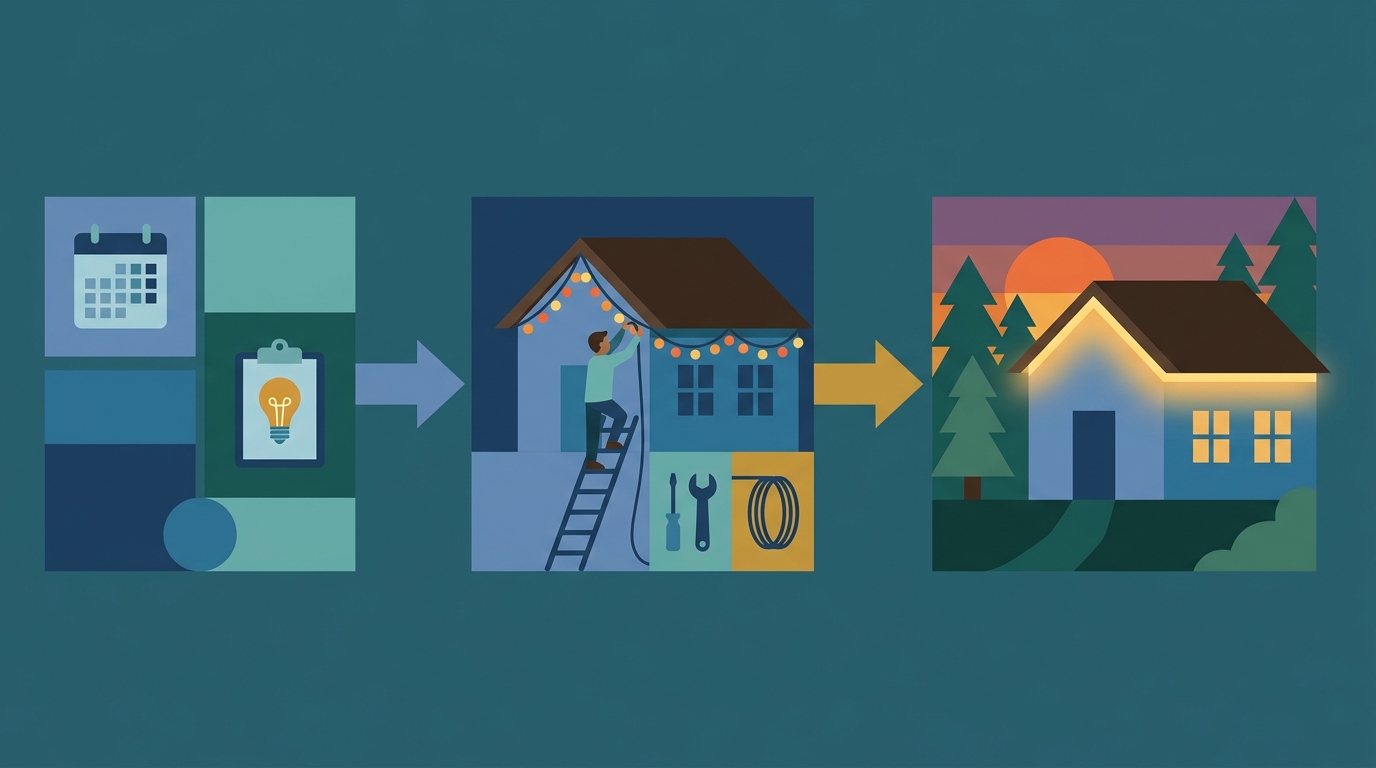
Here's the timeline most Everett homeowners should expect:
- Week 1: Consultation, site assessment, and design
- Week 2: Proposal review, contract, and product ordering
- Weeks 2–4: Material lead time and scheduling
- Installation day: Typically 1–2 days on site
- Final phase: App setup, walkthrough, and warranty registration
Total: roughly 3 to 6 weeks for most single-family homes. Larger properties in areas like Mill Creek, Silver Lake, or the View Ridge–Madison corridor may run longer, especially when multiple rooflines or detached structures are involved.
Phase 1: Consultation and Site Assessment (Days 1–5)
Every credible lighting project starts with someone walking your property — not a phone quote, not a satellite-image estimate.
During this phase, your installer measures linear footage along the eaves, fascia, and any architectural features you want lit. They check soffit depth, fascia condition, electrical access, and the location of your nearest exterior outlet or panel.
For Everett homes, this assessment also has to account for our specific reality: cedar shake roofs in older Bayside and Riverside neighborhoods, aluminum fascia on mid-century homes, and the weathered wood trim common on Craftsman-era properties near Grand Avenue Park. Each surface requires a different mounting approach.
What to prepare for your consultation
- A rough idea of your priority zones (front facade, garage, backyard, pool deck)
- Photos of any HOA architectural guidelines if you're in a managed community
- Your typical use case — holidays only, year-round accent, security, or all three
Phase 2: Design, Proposal, and Permitting (Days 5–10)
Within roughly a week of your site visit, you should receive a detailed proposal that includes the specific track color, fixture spacing, controller specifications, and a clear scope of work.
This is also when permitting questions get answered. Permanent lighting that ties into your existing exterior outlet generally doesn't require a permit in the City of Everett, but any work that involves a new dedicated circuit, sub-panel modification, or hardwiring falls under Washington State electrical code (WAC 296-46B) and requires a licensed electrician and an L&I electrical permit. A reputable installer will tell you upfront which category your project falls into.
If you live in an HOA-governed community — common in Everett's newer developments around Harbour Pointe and parts of north Everett — factor in 1–3 weeks for architectural review board approval. Don't skip this. Removal orders are far more expensive than waiting two extra weeks.
Phase 3: Product Ordering and Lead Time (Weeks 2–4)
Quality permanent lighting systems aren't stocked at the local hardware store. Track, fixtures, controllers, and color-matched channel are typically ordered per-project from the manufacturer.
Standard lead time runs 10–14 business days. Custom track colors or larger commercial-grade systems can stretch to four weeks.
If you're targeting a specific deadline — lighting up before Thanksgiving, ready for a December holiday display, or installed before the wet season truly settles in around mid-October — work backward from that date and add a two-week buffer. Everett installers book heavily from August through early November, and waiting until October to call about a Thanksgiving install is a common scheduling regret.
Phase 4: Installation Day (1–2 Days On Site)
The actual install is the fastest phase, which surprises many homeowners. A typical 200-linear-foot residential project takes one full day with a two-person crew.
Here's what happens on install day:
- Track is custom-cut and color-matched to your fascia or soffit
- Mounting hardware is secured with stainless fasteners (essential in our marine-influenced climate)
- Individual LED pucks are seated and spaced — typically every 4 inches
- Wiring is concealed and routed to the controller location
- Controller is mounted, powered, and connected to your home Wi-Fi
- System is tested through full color cycling and pattern verification
Weather plays a real role here. Installers in Everett generally avoid mounting work in steady rain — not because the system can't handle moisture once installed, but because adhesives and sealants need dry application conditions. A two-day forecast window of dry weather is standard.
Phase 5: App Setup, Walkthrough, and Handoff
The final phase is often rushed by less experienced installers, and it shouldn't be. Your control app needs to be configured, your common scenes built (holiday presets, accent white, security mode), and your warranty registered.
A proper walkthrough covers app navigation, manual override, seasonal scheduling, and what to do if a section ever needs service. Plan for 30–45 minutes at the end of installation day.
How Everett's Climate Shapes Your Project Timeline
Permanent lighting in the Puget Sound region has to perform through 150+ days of measurable rainfall annually, occasional freezing temperatures, and salt-influenced air closer to the waterfront. This affects timeline in two ways.
First, the ideal installation window runs from late spring through early fall. Projects scheduled between June and September benefit from longer dry stretches and faster cure times on adhesives and sealants.
Second, winter installations are absolutely possible — they just require more weather flexibility. If you're booking a January or February install, expect your installer to call once or twice to reschedule around storm systems. That's professionalism, not delay.
FAQ: Permanent Lighting Project Planning in Everett
How far in advance should I book for holiday lighting?
For guaranteed pre-Thanksgiving activation, book by mid-September. October bookings often slip into early December because of installer backlog and material lead times.
Do I need to be home during installation?
Yes for the start (access and final placement decisions) and the end (app setup and walkthrough). The middle hours of installation don't require your presence.
What can delay a permanent lighting project?
The three most common delays are HOA approval timelines, weather windows during the October–April wet season, and electrical work that requires a separately scheduled licensed electrician.
Can permanent lighting be installed in winter?
Yes, between weather systems. Crews need a dry installation window of roughly 8 hours. Snow and sustained rain push the schedule, but cold temperatures alone don't.
How long do permanent lighting systems last?
Quality systems carry manufacturer warranties of 3–5 years on fixtures and longer on track. Real-world lifespan in the Pacific Northwest typically exceeds a decade when properly installed and maintained.
Planning Your Project With Confidence
The homeowners who end up happiest with their permanent lighting are the ones who planned a realistic timeline — not the ones who got the fastest quote. Build in time for design, permitting where applicable, lead times, and weather. Choose an installer who walks your property, explains the electrical scope honestly, and stays for a proper walkthrough.
Homeowners in Everett who want a permanent lighting project handled with this level of project management can reach Velocity Cleaning Services at velocitycleaningsystems.com for a site assessment and timeline plan tailored to their property.