House Washing vs DIY: When to Hire Professionals in West of Market, Kirkland
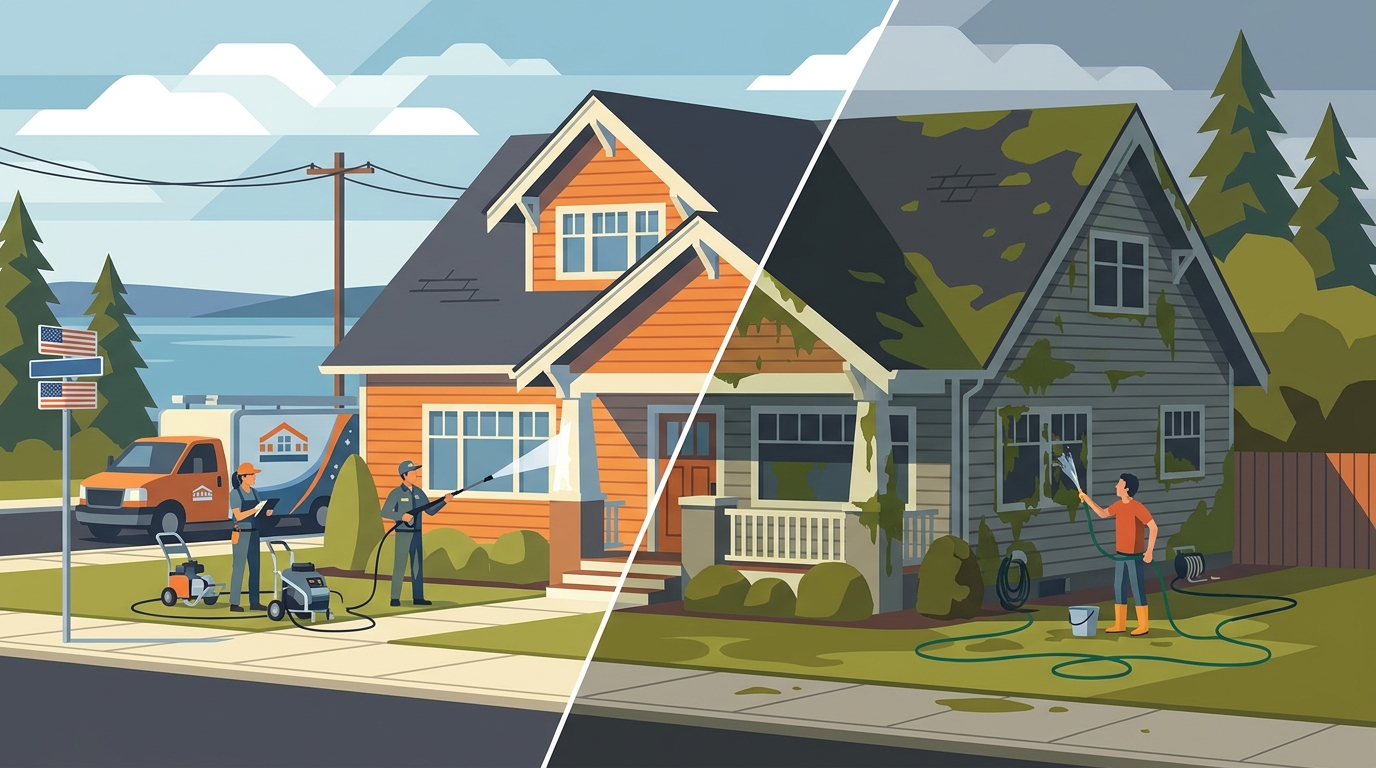
You've noticed the dark streaks creeping up the north side of your siding, the green film on the porch overhang, the chalky residue around the gutters. In West of Market, where mature cedars, lake-adjacent humidity, and shaded lots create ideal conditions for mildew and algae, that buildup is almost inevitable — and the question becomes whether to rent a pressure washer this weekend or call a professional.
The honest answer depends on your home, your tolerance for risk, and how you value your time. Here's how the two approaches actually compare for the housing stock typical of West of Market.
Why West of Market Homes Are a Specific Case
West of Market sits between Market Street and Lake Washington, a quiet residential pocket of older Craftsman bungalows, mid-century homes, and remodeled two-story houses on tree-lined streets. Three local realities shape how you should think about exterior cleaning here:
- Persistent moisture. Proximity to the lake, combined with the Pacific Northwest's long damp season from October through May, keeps siding wet for weeks at a time. Algae and mildew thrive.
- Heavy tree canopy. Mature evergreens drop needles, sap, and organic debris that feed mold growth on roofs, fascia, and north-facing walls.
- Mixed and aging housing stock. Older cedar siding, painted wood trim, and original window seals are far less forgiving of high-pressure water than newer fiber cement or vinyl found in some other Kirkland neighborhoods.
That last point matters most. A 3,000 PSI nozzle that's harmless on a concrete driveway can gouge soft cedar, drive water behind lap siding, or strip paint from century-old trim in seconds.
The Cost Comparison: What You'll Actually Pay
On paper, DIY wins on direct cash outlay. Renting a consumer-grade pressure washer in the Kirkland area typically runs $40–$100 per day, and detergents add another $20–$80. Total out-of-pocket for a DIY weekend lands in the $60–$250 range, or as low as $20–$80 if you already own a machine.
Professional house washing in Kirkland generally runs:
- $300–$450 for a small single-story home
- $400–$650 for an average two-story home (most West of Market houses fall here)
- $600–$900+ for larger or complex homes with steep rooflines and intricate trim
Kirkland and the broader Seattle metro run above the national average of $250–$400 because of higher labor and operating costs. Add-ons like driveway and walkway cleaning typically run $0.20–$0.40 per square foot, and roof soft washing is usually quoted separately at $400–$1,000+ depending on pitch and moss severity.
The DIY number looks compelling until you add the value of a lost weekend, the risk of damaging $20,000 worth of siding and trim, and the likelihood that algae returns within months because rinsing alone doesn't kill it at the root.
Can Pressure Washing Damage Your House? Yes — Easily.
This is the question most DIYers underestimate. Consumer pressure washers typically deliver 1,700–3,000 PSI, with heavy-duty units reaching 4,600 PSI. That's more than enough to:
- Etch and chalk vinyl or aluminum siding
- Gouge cedar shingles and painted wood trim
- Force water behind lap siding, soaking insulation and framing
- Strip paint from older window sashes and door casings
- Damage screens, roof shingles, and seal failures around windows
The U.S. Consumer Product Safety Commission has documented roughly 6,057 pressure-washer injuries annually nationwide, and a meaningful share involve homeowners working from ladders — exactly the scenario for any two-story job in West of Market.
Professional crews use soft washing for siding and roofs: pressure dropped to 300–500 PSI or lower, paired with commercial-grade surfactants and algaecides that kill organic growth biologically rather than blasting it off mechanically. The chemistry does the work; the water just rinses. That's the technique experienced operators like Velocity Cleaning Systems use on cedar, painted trim, and composite roofing where high pressure would cause real damage.
Cleaning Effectiveness and How Long Results Last
This is where professional service separates itself most clearly. A DIY rinse removes what you can see today. Within a few wet months, the mildew and algae spores left behind regrow — often faster, because the surface has been roughed up.
Professional soft washing applies biocides that kill spores at the root. Results typically last significantly longer, and in shaded West of Market lots with persistent canopy cover, that difference shows up as cleaner siding through a second winter rather than a slow return of green streaks by midsummer.
Commercial rigs also bring capability consumer machines don't: adjustable output from 40 to 5,000 PSI, flow rates of 3–8 GPM (versus 1.2–2.5 GPM for typical consumer units), and hot water capability up to roughly 250°F for stubborn organic staining.
Time, Convenience, and What a Professional Job Looks Like
A professional crew finishes an average Kirkland home in 2–4 hours. You schedule, provide hose access, and go about your day.
DIY for a full two-story exterior is typically a full weekend, sometimes several days for first-timers. That includes rental pickup and return, hose routing, mixing chemicals, repositioning ladders dozens of times, and cleanup. For a West of Market two-story with detailed trim and a complex roofline, plan on more.
How to Choose a Pressure Washing Company in Kirkland
If you decide to hire out, the criteria that actually matter are straightforward. Look for:
- Soft washing capability. Ask specifically how they clean siding and roofs. If the answer is "high pressure," keep calling. The right answer involves low PSI and substrate-matched detergents.
- Liability insurance and workers' comp. Reputable Kirkland operators carry both. If a worker is injured on your property and the company isn't insured, you may be exposed. Ask for a certificate.
- Washington State contractor registration. Verify the company is registered with the Washington State Department of Labor & Industries — it's the baseline legal requirement for service work on Kirkland homes.
- Local familiarity. Crews that regularly work in Kirkland understand cedar siding, moss-heavy roofs, and the seasonal timing that keeps results lasting through the wet months.
- Clear scope and pricing. A written estimate should specify the surfaces included, the chemistry being used, and whether items like driveways, walkways, gutters, or roof soft washing are extra.
- A satisfaction policy. There's no manufacturer-style warranty in this trade, but established companies stand behind their work with clear policies on touch-ups.
When DIY Actually Makes Sense
DIY isn't always wrong. It's a reasonable choice when:
- The job is limited to ground-level hard surfaces — a back patio, a short fence, a section of driveway
- You already own a pressure washer and know how to use it
- You're not working at height, and there's no soft cedar or original painted trim in the spray path
- You accept that results won't last as long as a soft wash
For a two-story West of Market home with mixed siding, mature trees, and visible algae on shaded walls, the math tilts hard the other way.
The Best Time to Wash Your House in Kirkland
Late spring through early fall — roughly May through September — is the practical window. You want surfaces to dry quickly and chemistry to perform at moderate temperatures. Many Kirkland homeowners schedule a wash after the heavy spring pollen drop and before fall debris begins, with a second look at the roof if moss has rebuilt over winter.
Frequently Asked Questions
Is professional house washing worth it for a single-story home?
Often yes, particularly if you have visible algae or mildew. Soft washing kills growth at the root and lasts longer than a DIY rinse. For a small single-story home, professional service typically runs $300–$450 in Kirkland.
What's the best way to clean the exterior of a house in the Pacific Northwest?
For siding and roofs, low-pressure soft washing with biocide-based chemistry. High pressure should generally be reserved for concrete, brick, and other hard surfaces — not cedar, vinyl, or painted wood.
How often should West of Market homes be washed?
Most homes benefit from a full exterior wash every 1–2 years given the shade and moisture in the neighborhood. Roofs with moss issues may need attention more frequently.
Will pressure washing damage my paint?
It can, especially on older painted trim or wood siding. This is the primary reason professionals use soft wash techniques on painted and delicate surfaces.
The Bottom Line for West of Market Homeowners
For small, ground-level hard surfaces, DIY pressure washing is a defensible choice if you have the equipment and experience. For the typical West of Market home — two stories, mixed siding, mature trees, shaded walls with visible organic growth — professional soft washing is the safer and more durable path. You avoid the ladder risk, you avoid the damage risk, and you get results that hold up through Kirkland's long wet season.
Homeowners in West of Market and the wider Kirkland area who want this handled professionally can reach Velocity Cleaning Systems at https://velocitycleaningsystems.com/ for a free estimate.