Black Streaks and Moss on Lynnwood Roofs: Causes and Fixes
You've noticed the dark streaks running down your shingles. Maybe a fuzzy green carpet creeping along the north-facing slope. If you live anywhere from Alderwood to Martha Lake to Meadowdale, you're seeing what nearly every Lynnwood homeowner deals with eventually. The Pacific Northwest climate is generous with rain, shade, and cool temperatures — which happens to be the exact recipe for roof algae and moss.
Here's what's actually happening up there, why Lynnwood roofs get hit harder than most, and how to fix it without wrecking your shingles in the process.
What Causes Black Stains and Moss on Roofs in Lynnwood, WA
Those black streaks aren't dirt. They aren't mildew either. They're a hardy cyanobacteria called Gloeocapsa magma — a blue-green algae that feeds on the limestone filler in asphalt shingles and forms dark, water-resistant colonies. As colonies grow and die, they leave the black staining you see cascading down your roof.
Moss is a different organism entirely. It's a true plant with tiny root-like structures called rhizoids that pry between shingles and hold moisture against the roof deck. Where algae stains a roof, moss destroys it.
Lynnwood offers both organisms an almost perfect habitat:
- Persistent moisture. Snohomish County averages well over 40 inches of rain a year, and much of it falls between October and May as steady drizzle rather than fast-drying downpours.
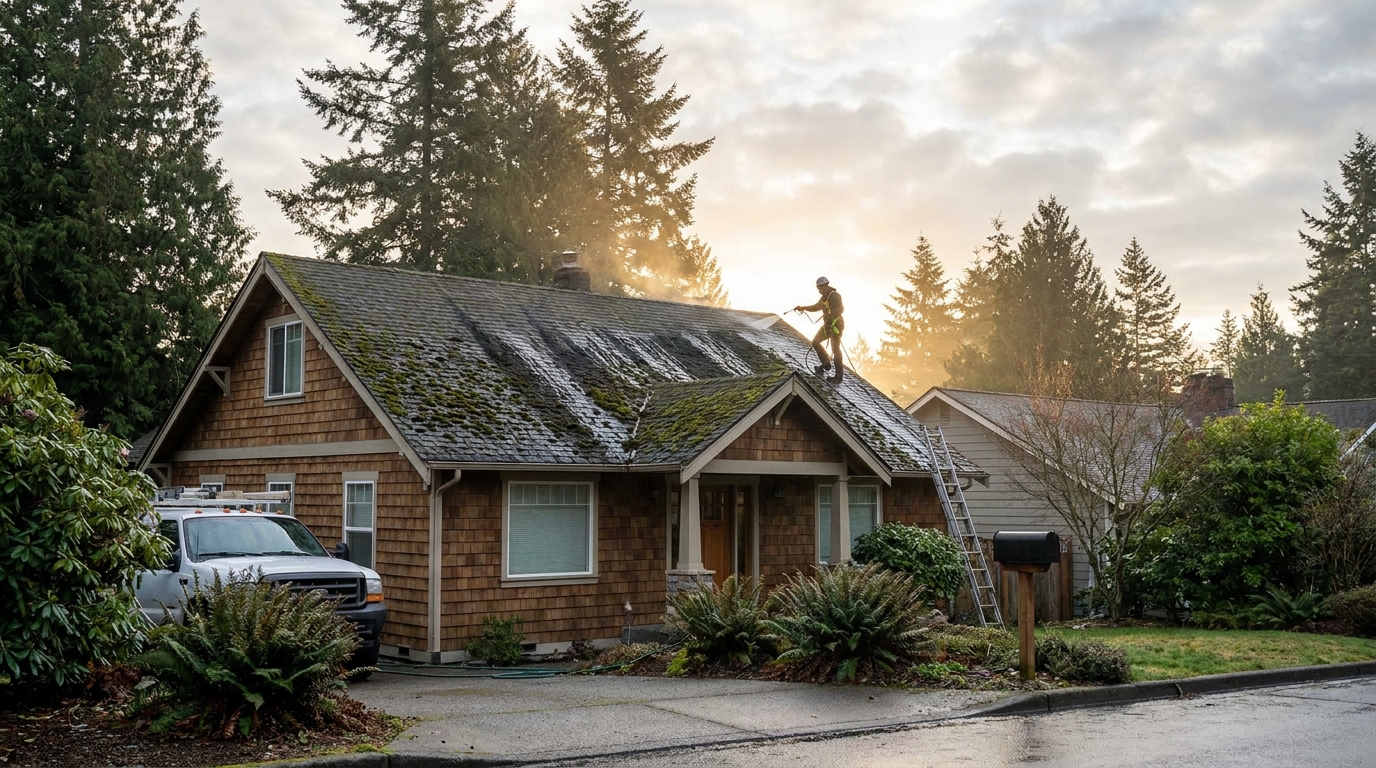
- Tree canopy. Neighborhoods like Alderwood Manor, North Lynnwood, and the areas bordering Scriber Lake Park are heavily shaded by Douglas fir, western red cedar, and bigleaf maple. Shade keeps roofs damp for days.
- Mild temperatures. Winters rarely freeze hard enough to kill spores, and summers rarely get hot enough to bake the roof dry for long.
- Airborne spores. Moss and algae spores travel on wind from surrounding forests, greenbelts, and neighboring roofs. Once one house on a block is infested, the rest are next.
North- and west-facing slopes get hit first because they see the least direct sun. If you're standing in your driveway looking up and only one side of the roof looks bad, that's why.
Why This Matters More Than It Looks
Algae staining is mostly cosmetic — though it can cut your roof's reflectivity and raise attic temperatures. Moss is a structural problem.
- Moss lifts shingle edges, exposing the nail line and underlayment to wind-driven rain.
- It holds moisture against the shingle mat, accelerating granule loss and rot.
- In freeze events — the kind Lynnwood sees a handful of times each winter — trapped water expands and cracks the shingle surface.
- Left long enough, moss voids most asphalt shingle warranties and shortens roof life by years.
A roof that should last 25 to 30 years in a drier climate can fail in 15 to 18 years in Lynnwood if moss is ignored.
How to Remove Algae From a Roof in Lynnwood
The wrong answer is a pressure washer. High-pressure spray blasts the protective granules off asphalt shingles, shortening roof life dramatically and often voiding manufacturer warranties. It's the single most common DIY mistake we see in Snohomish County.
The right answer is a soft wash: low-pressure application of a treatment solution — typically a diluted sodium hypochlorite blend with surfactants — that kills algae and moss at the spore level, then rinses gently. Done properly, soft washing:
- Kills Gloeocapsa magma on contact and lifts the black staining
- Reaches into moss root structures rather than just skimming the surface
- Leaves no residual damage to shingles, flashing, or gutters
- Buys you 3 to 5 years before regrowth in most Lynnwood microclimates
For moss specifically, professional cleaners often combine soft washing with gentle manual removal after the moss has been killed and dried out. Trying to scrape live, wet moss off shingles pulls granules with it — you want it dead and brittle first.
The Best Way to Clean a Roof Without Damaging It
If you're weighing your options in Lynnwood, here's the short version of what actually works:
- Skip the pressure washer. Full stop.
- Skip the wire brush and stiff scraping tools. They strip granules.
- Use a soft-wash treatment matched to your roof material — asphalt, cedar shake, metal, and tile all respond differently.
- Time it right. Late spring through early fall is ideal in the Puget Sound region. You need dry weather for the treatment to dwell properly, which is scarce between November and March.
- Install zinc or copper strips along the ridge line as a preventive measure. Rainwater carries trace metal ions down the roof and inhibits regrowth.
What About DIY?
You can DIY a roof cleaning in Lynnwood, but honestly weigh the tradeoffs before you climb up there.
- Slope and moss are a bad combination. Wet moss on a pitched roof is roughly as slippery as ice.
- Chemical handling matters. Runoff from sodium hypochlorite solutions can damage landscaping, kill grass, and stain concrete if not managed correctly. Snohomish County storm drain rules also govern what can be discharged into the street.
- Ladder height and roof pitch on many Lynnwood homes — particularly two-story builds in Lake Serene and the newer developments off 164th — put homeowners well above safe DIY territory.
If you're comfortable on the ground with a pump sprayer and your roof is a single-story ranch with easy access, a spring treatment with a commercial soft-wash concentrate is doable. Anything more complex is worth pricing out with a professional.
How Often Should Lynnwood Roofs Be Cleaned?
Most homes in the area benefit from a soft-wash treatment every 3 to 5 years, with a light annual moss inspection each fall before the wet season arrives. Homes under heavy tree cover — think anywhere near Lund's Gulch, Meadowdale Beach Park, or the wooded lots east of I-5 — often need it closer to every 2 to 3 years.
Frequently Asked Questions
Will bleach damage my Lynnwood roof?
Properly diluted sodium hypochlorite applied at low pressure is the industry-standard treatment for asphalt shingles and is safe when done correctly. The damage comes from over-concentration, pressure washing, or letting runoff sit on landscaping and siding.
Can I just wait for rain to wash the streaks off?
No. Rain feeds algae and moss — it doesn't remove them. Streaks only get worse until the organisms are killed at the source.
Does homeowners insurance cover moss damage?
Almost never. Moss damage is considered a maintenance issue, not a covered peril. That's why treating it early is far cheaper than the alternative.
How do I find reliable roof moss removal near me in Lynnwood, WA?
Look for local operators who specifically use soft-wash methods, carry liability insurance for roof work, and can explain their treatment chemistry. Ask whether they include gutter cleanout and whether they offer preventive zinc strip installation — those are signs of a company that understands Pacific Northwest conditions.
The Bottom Line for Lynnwood Homeowners
Black streaks and moss aren't a sign you did something wrong. They're a sign you own a roof in the Pacific Northwest. The organisms are relentless, but the fix is straightforward when it's done with the right method and the right timing.
Homeowners in Lynnwood, WA who want this handled professionally can reach Velocity Cleaning Systems at https://velocitycleaningsystems.com/ for a free estimate. The team focuses on soft-wash roof cleaning built around local conditions — the shade, the rain, the tree cover — that make this such a persistent problem for homes across Snohomish County.