Best Time of Year for Gutter Cleaning in Lynnwood
If you've lived through a single winter in Lynnwood, you already know the answer to one question: clogged gutters and Pacific Northwest rain are a bad combination. The harder question is when exactly to schedule cleaning to stay ahead of the weather — and how often it really needs to happen.
This guide walks through the best time of year to clean gutters in Lynnwood, what makes our local climate uniquely demanding on gutter systems, and how to think about scheduling so you're not reacting to overflow during the first November atmospheric river.
The Short Answer: Late Fall and Early Spring
For most Lynnwood homes, the two non-negotiable cleaning windows are late October through mid-November and March through April. That cadence covers the two heaviest debris events of the year in Snohomish County: the fall conifer and deciduous drop, and the spring shed of seed pods, blossoms, and catkins from cottonwoods, alders, and big-leaf maples.
If you only clean once a year, the late-fall slot is the one that matters most. By Halloween, most leaves have come down, and you want gutters clear before the sustained rain settles in for the season.
Why Lynnwood's Climate Changes the Calendar
Generic gutter advice written for the rest of the country doesn't translate well here. Lynnwood gets roughly 40+ inches of rain a year, with the bulk falling between November and March. That's a sustained, low-intensity soak rather than the heavy summer thunderstorms that dominate the South or Midwest.
What that means for your gutters:
- Wet debris stays wet. Leaves and needles that fall in October don't dry out and blow away — they compact into a dense mat that holds water against your fascia for months.
- Douglas fir and Western red cedar needles are the real enemy. Unlike broad leaves, conifer needles slip through most basic gutter guards, accumulate in elbows, and form clogs deep in downspouts.
- Moss thrives here. Neighborhoods with mature tree canopy — think Martha Lake, Alderwood, and the older streets around Scriber Lake — see moss colonizing both roofs and gutters by midwinter, which compounds drainage problems.
The Pacific Northwest pattern is why scheduling around the calendar (rather than waiting until you see overflow) matters so much in this market.
Seasonal Breakdown for Lynnwood Homeowners
Fall (October–November): The Critical Cleaning
This is the appointment you don't skip. Aim for the last two weeks of October or the first week of November, after the bulk of leaf drop but before the first sustained rain stretch. Cleaning too early in October often means a second pass is needed; cleaning in December means you've already had four to six weeks of overflow potentially saturating siding, soffits, and foundation soil.
If your property backs up to greenbelt or has heavy fir cover — common throughout the Lake Stickney, Picnic Point, and North Lynnwood areas — you may need both an early-October and late-November visit.
Spring (March–April): The Cleanup Pass
Spring cleaning catches what winter storms blew in and clears the seed-pod debris that follows. It also gives you a chance to inspect for winter damage — separated joints, loose hangers, or sagging sections caused by ice or the weight of saturated debris.
Summer (June–August): The Inspection Window
Summer is the easiest season to work on gutters, even if cleaning isn't urgent. Dry conditions make repairs, resealing, and gutter guard installation straightforward. If you're planning any roof work or exterior painting, schedule gutter service to coordinate.
Winter (December–February): Reactive Only
You generally don't want crews on ladders during a Lynnwood winter storm. But if you notice overflow, ice damming at the eaves during a cold snap, or water sheeting down siding, a midwinter emergency cleaning is worth it to prevent foundation and fascia damage.
How Often Should You Actually Clean?
For Lynnwood specifically:
- Twice a year is the baseline for homes with average tree exposure.
- Three to four times a year is realistic for homes with heavy conifer cover or properties near mature greenbelts.
- Once a year only works for homes with minimal tree exposure and quality gutter guards — and even then, an annual inspection is wise.
How Long Does Gutter Cleaning Take?
For a typical single-story Lynnwood home, professional gutter cleaning takes about 45 minutes to an hour. A two-story home with complex rooflines, dormers, or steep pitches usually runs 1.5 to 2.5 hours. Add time if downspouts are clogged deep in the system or if moss treatment is part of the visit.
The variables that extend a job in our market:
- Heavy conifer needle compaction in downspouts
- Moss buildup requiring scraping rather than simple debris removal
- Three-story sections common in newer developments along 164th and in the hills above Alderwood Mall
- Underground downspout extensions that need flushing
Is Gutter Cleaning Worth It?
For Lynnwood homeowners, the answer is unambiguously yes — and the math is straightforward. A professional cleaning costs a small fraction of what fascia replacement, siding repair, or foundation drainage work costs. Water that overflows clogged gutters during a Pacific Northwest winter doesn't just disappear; it saturates the soil at your foundation, rots wood trim, and finds its way into crawl spaces.
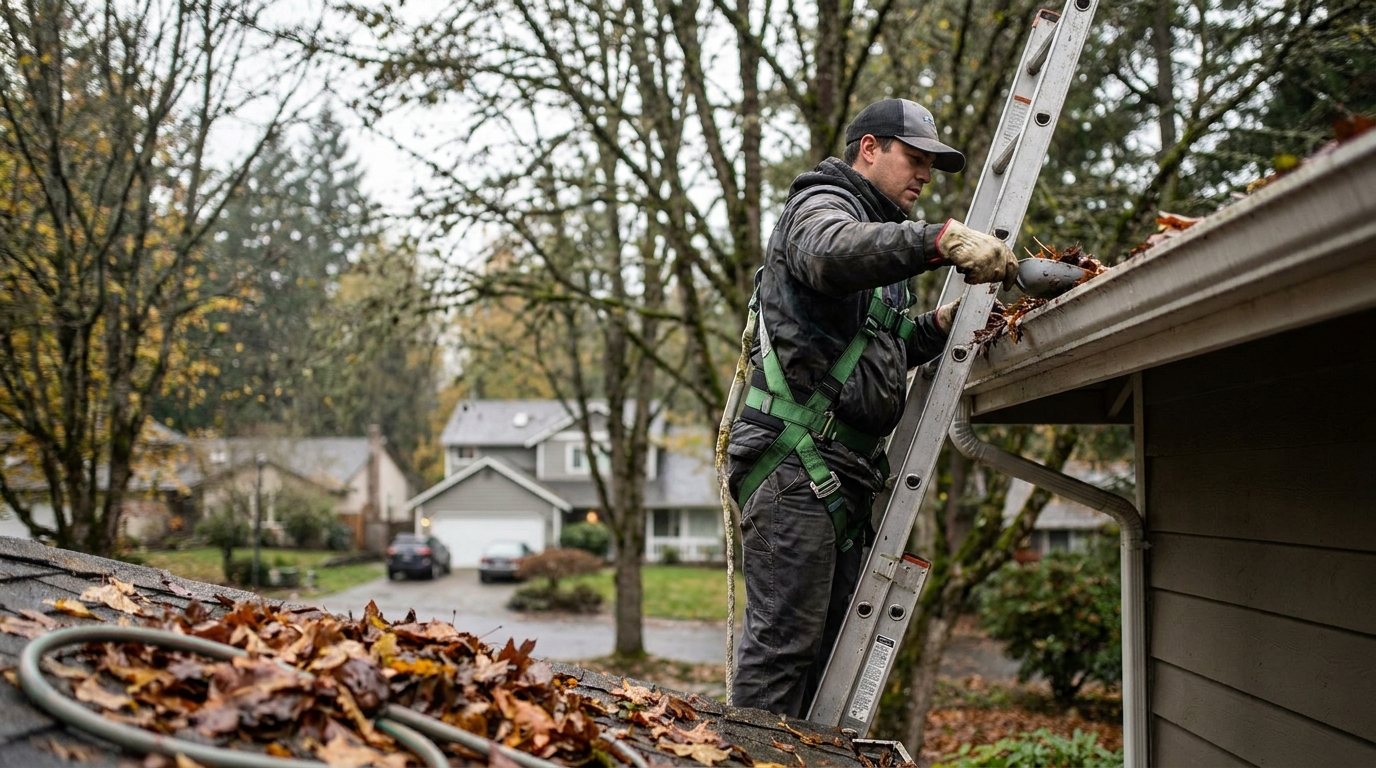
The other factor people underestimate: ladder work on a wet, mossy Lynnwood roof in October is genuinely dangerous. Most serious homeowner ladder injuries in the region happen during DIY gutter cleaning in marginal weather. Hiring it out isn't just convenience — it's risk management.
Local Rules Worth Knowing
Routine gutter cleaning in Lynnwood doesn't require a permit. However, if a cleaning visit turns up damage that requires gutter replacement or significant roof work, contractors performing that work in Washington must be registered with the Washington State Department of Labor & Industries. It's worth confirming any company you hire — for cleaning or repair — carries current L&I registration and liability insurance, since homeowner policies generally won't cover injuries to uninsured workers on your property.
FAQs
What month is best to clean gutters in Lynnwood?
Late October to mid-November is the most important cleaning of the year, timed after leaf drop but before sustained winter rain. A second cleaning in March or April is recommended for most homes.
Can I wait until spring if I missed fall cleaning?
You can, but you're rolling the dice on overflow damage. If you missed the fall window, schedule cleaning as soon as you have a dry stretch — don't wait until April.
How do I know if my gutters need cleaning sooner?
Watch for water sheeting over the front edge during rain, plants sprouting from the gutter line, sagging sections, or staining on the siding below the gutter. Any of these mean you're overdue.
Do gutter guards eliminate the need for cleaning?
No. Quality guards reduce frequency, but Pacific Northwest conifer needles, moss, and grit still accumulate above and below the guard system. Plan on at least an annual inspection and cleaning even with guards installed.
Planning Your Schedule
The homeowners who avoid gutter problems in Lynnwood aren't the ones with special equipment or unusual luck — they're the ones who put cleaning on the calendar twice a year and treat it as routine maintenance rather than a reaction to a problem. Book your fall slot in September if you can, since late-October availability tightens quickly across Snohomish County.
Homeowners in Lynnwood, WA who want this handled professionally can reach Velocity Cleaning Systems at https://velocitycleaningsystems.com/ for a free estimate. The team works throughout Lynnwood and the surrounding Snohomish County area and can advise on the right cadence for your specific tree exposure and roof profile.