
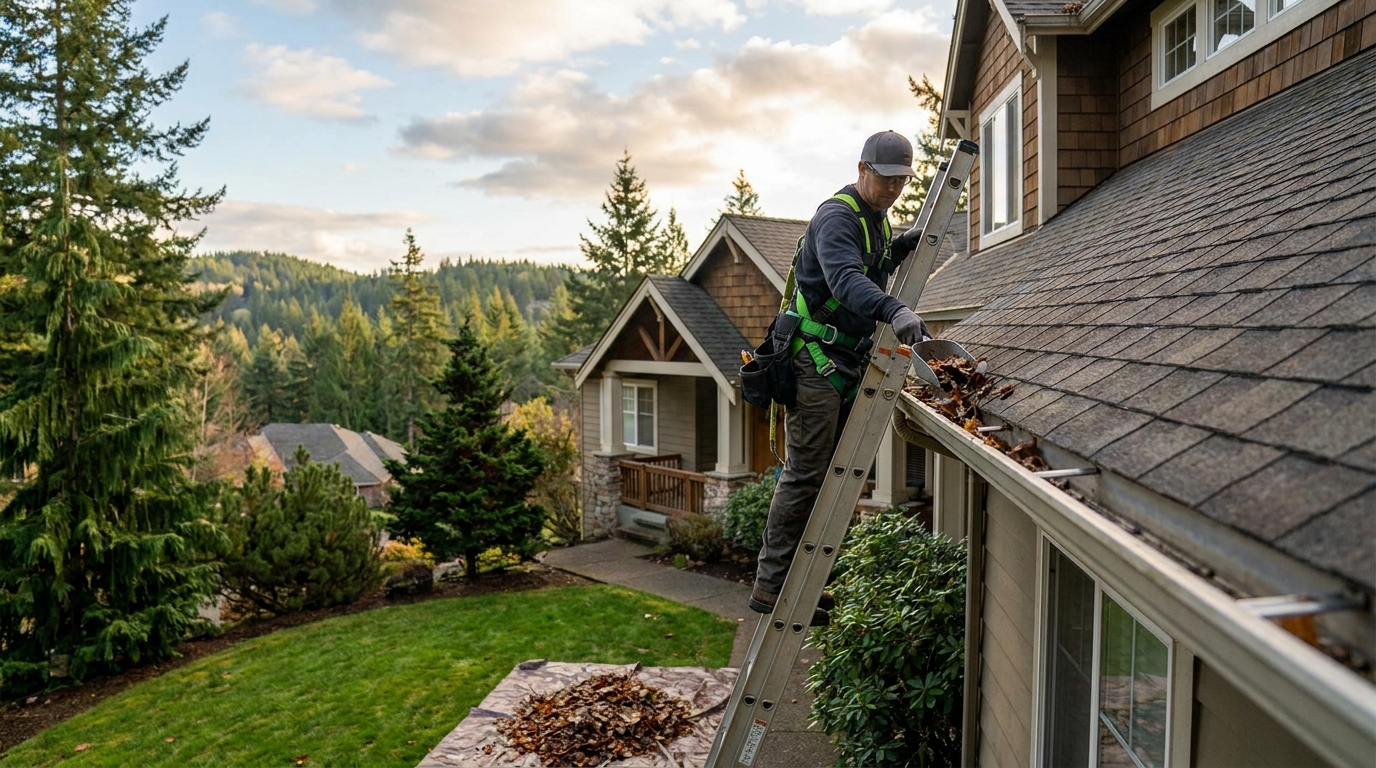
When to Schedule Gutter Cleaning in Sammamish: Seasonal Timing Guide
If you've ever stood under an overflowing downspout during a November atmospheric river, you already know the question isn't whether to clean your gutters in Sammamish — it's when. Get the timing wrong and you're paying for fascia repair, soggy crawlspaces, or worse. Get it right and a routine cleaning protects your home for the entire wet season.
Sammamish sits in one of the most gutter-punishing microclimates in the Puget Sound region. Heavy conifer canopy, 47+ inches of annual rainfall, and a leaf drop that stretches from September into January make this market different from almost anywhere else in the country. Here's how to think about scheduling.
Why Gutter Cleaning Timing Matters More in Sammamish
Sammamish homes deal with a debris cocktail most regions don't face. Douglas fir needles shed year-round. Western red cedar drops scale-like foliage in late summer. Bigleaf maples dump enormous, slow-decomposing leaves from October through December. And the Sammamish Plateau's elevation means colder, wetter conditions than lower-lying Bellevue or Redmond.
That combination clogs gutters faster than the national average. A home in Klahanie or Trossachs surrounded by mature evergreens often needs cleaning two to three times a year — not the once-annually advice you'll find in generic homeowner blogs.
The cost of skipping a cleaning is real. Overflowing gutters in our climate saturate foundation soil, and Sammamish's glacial till substrate doesn't drain quickly. Water pools, freezes during the occasional January cold snap, and pushes against foundations and siding.
The Two Cleanings Every Sammamish Home Needs
Late Fall: Mid-November to Early December
This is the non-negotiable cleaning. By mid-November, most deciduous leaves have dropped, and you want gutters clear before the heaviest sustained rainfall hits in late November through January.
Schedule too early — say, mid-October — and you'll clean again in three weeks as the maples finish dropping. Schedule too late, into January, and you've already absorbed weeks of overflow damage.
The sweet spot for most Sammamish neighborhoods is the two-week window after Veterans Day but before Thanksgiving. Homes near Beaver Lake, Pine Lake, and the wooded sections off 228th Ave SE often benefit from the later end of that window because of how long maple leaves linger.
Late Spring: April to Early May
The second cleaning addresses what late fall and winter left behind: rotting leaf mash compacted by months of rain, plus the spring debris load. Cedar and fir drop catkins, pollen cones, and seed husks heavily in April and May.
A spring cleaning also lets you inspect for winter damage — sagging sections, loose hangers, separated seams — before summer dry weather makes repairs easier and cheaper.
When a Third Cleaning Makes Sense
Some Sammamish properties genuinely need three visits per year. You probably fall into this category if:
- Your lot has four or more mature evergreens within 20 feet of the roofline
- You live in heavily treed neighborhoods like Timberline, Inglewood, or parts of Sahalee
- Your roof has low-pitch sections or complex valleys that trap needles
- You've had ice dam issues in previous winters
For these homes, a late August or early September cleaning catches the summer needle drop before fall leaves arrive, preventing the compacted mat that's nearly impossible to flush out later.
Months to Generally Avoid
Not every month is a good cleaning month in Sammamish.
January and February: Roof surfaces are slick, frost is common in the early mornings on the Plateau, and ladder work is genuinely dangerous. Emergency cleanings happen, but routine scheduling here is a mistake.
Mid-October: Leaves are still falling. Whatever you clean today will be clogged in two weeks.
June and July: Gutters are usually at their cleanest of the year. Unless you're addressing a specific problem, you're paying for a service you don't yet need.
How Sammamish Weather Patterns Should Shape Your Schedule
Watch the forecast, not just the calendar. The shift from light autumn showers to sustained rainfall typically happens between late October and mid-November. NOAA's Western Region forecasts and King County stormwater advisories are reasonable signals — when you start seeing atmospheric river language in 10-day forecasts, your fall cleaning window is closing.
Spring timing is similarly weather-dependent. Wait until after the last meaningful rain event in April, when downspouts have a chance to dry and debris isn't a soaking mess that's harder (and pricier) to remove.
What Professional Cleaning Should Include
Scheduling the right month only matters if the cleaning itself is thorough. A proper Sammamish gutter service should include:
- Full hand-removal of debris from gutter troughs (not just blowing leaves out)
- Downspout flushing and clearing — critical for the long runs common on two-story Plateau homes
- Inspection of hangers, seams, and fascia for water damage
- Roof valley clearing where needles accumulate
- Debris haul-away rather than dumping in your landscape beds
At Velocity Cleaning Services, we structure visits around the Sammamish seasonal rhythm — most clients are on a two-visit annual plan, with heavily treed properties moving to three. The goal is to match the cleaning calendar to your specific tree cover and roof complexity, not a generic schedule.
Frequently Asked Questions
How often should I clean gutters if I have a gutter guard system?
Guards reduce frequency but don't eliminate it, especially in Sammamish. Fine debris like fir needles, pollen, and shingle grit still accumulates on top of and underneath most guard systems. Plan on at least one annual professional cleaning even with guards installed.
Is it safe to clean my own gutters on the Plateau?
It depends on roof pitch, height, and your comfort on ladders. Two-story homes with steep pitches — common in newer Sammamish developments — are responsible for a disproportionate share of homeowner ladder injuries each year. If you're not confident, professional service is the safer call.
What does gutter cleaning cost in Sammamish?
Pricing varies by home size, roof complexity, debris load, and accessibility. Single-story homes with modest tree cover sit at the lower end; large two-story homes surrounded by evergreens cost more. Most reputable Sammamish providers offer free estimates after seeing the property.
Should I clean gutters before or after the roof is power-washed or moss-treated?
After. Moss treatments and roof debris dislodge material that flows directly into gutters. Cleaning afterward captures all of it in one pass.
What's the warning sign I waited too long?
Visible overflow during rain is the obvious one. Less obvious: streaking on siding below gutter seams, soil erosion at downspout outlets, and small plants growing out of the gutter line. All three mean cleaning was overdue weeks ago.
Building a Schedule That Works for Your Home
The right answer to "when should I schedule gutter cleaning in Sammamish" depends on your tree cover, roof design, and how much risk you're willing to absorb. For most homes, the framework is straightforward: one cleaning in the November window, one in late spring, and a third in early fall if evergreens dominate your lot.
Homeowners in Sammamish who want this handled professionally — with timing matched to local conditions rather than a national calendar — can reach Velocity Cleaning Services at https://velocitycleaningsystems.com/ for a free estimate.