Signs Your Roof Needs Cleaning in Everett, WA
If you're standing in your driveway squinting up at green streaks, dark stains, or a fuzzy carpet spreading across your shingles, your roof is telling you it needs attention. In Everett, WA, the combination of marine air, long wet seasons, and heavy tree cover means most roofs show cleaning signals well before homeowners notice them. This checklist walks through the specific visual and seasonal cues that indicate it's time to clean — and how to tell the difference between cosmetic buildup and something that's actively shortening your roof's life.
The Short Answer: When to Clean a Roof in Everett, WA
Clean your roof when you can see moss clumps, dark streaks, lifted shingles, or clogged gutters — and inspect it at least twice a year given Everett's climate. The Puget Sound region's cool, damp weather from October through May creates near-perfect conditions for moss and algae, which is why local roofs often need cleaning every 2-3 years rather than the 5-7 year interval common in drier markets.
If you're seeing more than one of the signs below, the roof is past due.
Visual Signs Your Roof Needs Cleaning
These are the diagnostic signals you can spot from the ground with a decent pair of eyes or a phone zoom. You don't need to climb up — in fact, please don't.
1. Green or Gray Moss Clumps on Shingles
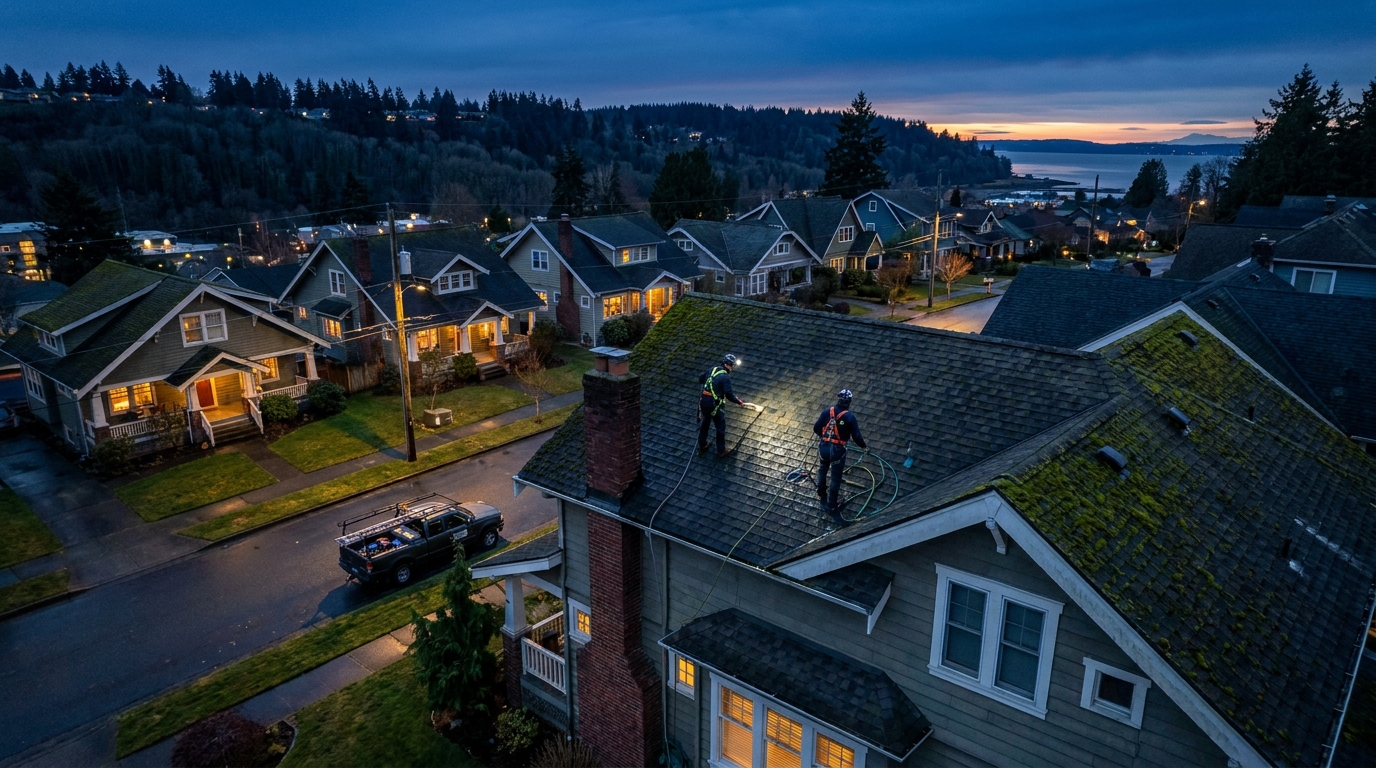
Moss is the number-one roof cleaning trigger in Everett. It starts as a thin green haze between shingle courses, then thickens into raised, spongy clumps that lift shingle edges. Once moss lifts a shingle, water gets underneath, and you're on the path to leaks and premature replacement. Neighborhoods with heavy tree canopy — think Silver Lake, Pinehurst-Beverly Park, and the older streets around North Everett — see this fastest because shaded, damp roofs never fully dry out.
2. Dark Streaks Running Down the Slope
Those black or brown vertical streaks aren't dirt. They're Gloeocapsa magma, an airborne algae that feeds on limestone filler in asphalt shingles. It's cosmetic at first but degrades granules over time, which is what protects the shingle from UV. If your north-facing slope looks noticeably darker than the south-facing side, algae is the reason.
3. Granules in the Gutters or at Downspout Outlets
Scoop a handful from the gutter. If it looks like coarse black sand, those are shingle granules — and they're supposed to be on your roof, not in your gutter. Moss and algae accelerate granule loss. A cleaning (and treatment) now can slow that timeline; ignoring it means shingle replacement sooner.
4. Lifted, Curling, or Cupped Shingles
Walk the perimeter and look at the shingle edges. Any lifting or curling suggests moss has been working underneath, moisture is trapped, or the shingle has aged past its useful life. Cleaning won't reverse curl, but it can stop the process before more shingles are affected.
5. Debris Piled in Valleys and Around Vents
Fir needles, cedar debris, and maple leaves collect in roof valleys and behind chimney flashing. In Everett's rainy stretch from November through March, that debris holds water directly against your roofing materials 24/7. Clear valleys are one of the simplest indicators of a well-maintained roof.
6. Overflowing or Slow-Draining Gutters
If water sheets over the front edge of your gutters during a rainstorm, they're blocked — usually with a mix of needles, granules, and moss fragments washed down from above. Roof cleaning and gutter cleaning are typically done together for this reason.
7. Stains on Siding or Fascia Below the Roofline
Green or black streaks running down siding directly below the gutter line mean contaminated water is spilling from the roof. That's a roof problem manifesting on your walls.
Seasonal Timing: When to Clean Roofs in Everett
The best window to clean a roof in Everett is late spring through early fall — roughly May through September — when the roof is dry enough for safe work and treatments have time to cure before the wet season returns. Here's how the calendar tends to play out locally:
- April–May: Inspect after winter. Moss growth peaks in early spring after months of wet weather. This is prime cleaning season.
- June–August: Ideal working conditions. Soft-wash treatments applied now have weeks of dry weather to work.
- September–October: Last practical window before the rains return. A pre-winter cleaning and gutter clear-out is one of the smartest maintenance moves you can make in Snohomish County.
- November–March: Wet, dark, and slippery. Emergency work happens; routine cleaning generally doesn't.
Inspection Checklist Before You Book a Cleaning
Before scheduling, do a quick ground-level walk-around and note what you see. A reputable cleaner will ask about most of these anyway.
- Roof material (asphalt shingle, cedar shake, metal, tile) and approximate age
- Which slopes show moss or streaking, and how heavy
- Any known leaks, interior stains, or attic moisture issues
- Tree cover and how much debris typically lands on the roof
- Gutter condition and last time they were cleared
- Any prior cleaning or moss treatments, and roughly when
This is the same intake information the crew at Velocity Cleaning Systems asks for when preparing an estimate, and it's what separates a quick quote from an accurate one.
Pressure Washing vs. Soft Washing: Choose Carefully
For asphalt shingles — the dominant roof type across Everett — pressure washing is the wrong tool. High pressure strips granules and voids many shingle manufacturer warranties. The correct approach is soft washing: low-pressure application of a cleaning solution that kills moss and algae at the root, followed by gentle rinsing and, in most cases, a preventive treatment that slows regrowth for 1-3 years.
When you're evaluating providers, ask specifically what pressure and what solution they use on your roof type. Anyone who answers "we just blast it off" is a company to skip.
Frequently Asked Questions
How often should I clean my roof in Everett, WA?
Every 2-3 years for most homes, and annually for heavily shaded properties with significant tree cover. Everett's damp climate accelerates moss and algae growth well beyond national averages, so the "once a decade" advice you'll read online doesn't apply here.
Is moss on my roof actually a problem, or just ugly?
It's a real problem. Moss holds moisture against shingles, lifts shingle edges, and creates pathways for water intrusion. Left alone, it shortens roof life by years and can void warranty coverage.
Can I clean the roof myself?
You can, but the risk-reward is poor. Wet Everett roofs are dangerously slick, the correct soft-wash chemistry requires the right dilution and PPE, and one slip changes your life. Most homeowners find that hiring a licensed, insured cleaner is worth it for the safety alone.
What should I ask a roof cleaning company before hiring?
Ask about licensing and insurance in Washington State, the exact cleaning method they use on your roof type, whether they offer a moss prevention treatment, and whether the estimate is written and itemized. Velocity Cleaning Systems, for example, provides written estimates and a detailed scope up front, which is the level of transparency to look for. One reviewer described the process as "a very detailed description of the work to be performed... followed by a written estimate" — that's the standard.
Will roof cleaning damage my landscaping?
It shouldn't, if the crew preps properly. Good soft-wash operators pre-wet plants, tarp sensitive areas, and rinse afterward. Ask specifically about landscape protection during your estimate.
The Bottom Line
Roofs in Everett tell you when they need cleaning — you just have to look. Moss clumps, dark algae streaks, granules in the gutter, debris in the valleys, and stained siding below the roofline are the clearest signals. Given the local climate, a two-year cleaning rhythm keeps most homes ahead of the damage curve, with inspection each spring and a pre-winter clear-out in early fall.
Homeowners in Everett, WA who want this handled professionally can reach Velocity Cleaning Systems at https://velocitycleaningsystems.com/ for a free estimate. The company works across Snohomish County, uses soft-wash methods appropriate for local roof types, and holds a 4.8-star rating across recent Google reviews — useful context if you'd rather have a trained crew make the diagnosis for you.