Pressure Washer PSI Settings: Surface-Specific Cleaning Guide for Everett Homes
You rented a pressure washer, pointed it at your driveway, and now there's a wand-shaped scar gouged into the concrete. Or you blasted your cedar siding and stripped half the stain off. Sound familiar?
PSI matters. So does GPM, nozzle angle, distance, and dwell time. Get any of those wrong on the wet, moss-prone surfaces common across Everett, and you trade one problem for a worse one.
This guide breaks down the correct pressure washer PSI settings for every surface you're likely to clean around a Snohomish County home — and where the line sits between a weekend project and a job worth handing off.
Why PSI Settings Matter More in Everett
Everett's marine climate does specific things to exterior surfaces. Persistent winter rain feeds moss and algae on north-facing roofs. Salt air off Port Gardner Bay leaves film on siding in neighborhoods like Port Gardner, Bayside, and Riverside. Cedar — the dominant siding material on mid-century homes through Silver Lake and View Ridge — drinks up moisture and softens, which means it bruises under high pressure.
Then there's mildew. The Pacific Northwest's eight-month wet season turns concrete walkways into slip hazards by February. Homeowners often crank PSI to compensate, which etches the surface and creates more porous texture for the next round of growth.
The right approach is matching pressure to the substrate — not muscling through it.
PSI Settings by Surface
Concrete Driveways and Sidewalks: 3,000–4,000 PSI
Concrete is the most forgiving surface, but only if it's in good condition. Use a 25-degree nozzle, hold the wand 8–12 inches off the surface, and keep moving. A surface cleaner attachment — that round disc with two rotating jets underneath — produces far more even results than a wand alone.
For older concrete with hairline cracks, drop to 2,500 PSI. Anything more drives water into the substrate and accelerates spalling during the next freeze.
Pavers and Stamped Concrete: 1,500–2,500 PSI
Pavers are joint-sand sensitive. Hit them at 3,500 PSI and you'll blow out the polymeric sand between every stone, which then needs to be re-swept and re-activated. Use a 25- or 40-degree tip, hold further back (12–18 inches), and plan to refresh sand afterward.
Wood Decks and Cedar Siding: 500–1,200 PSI
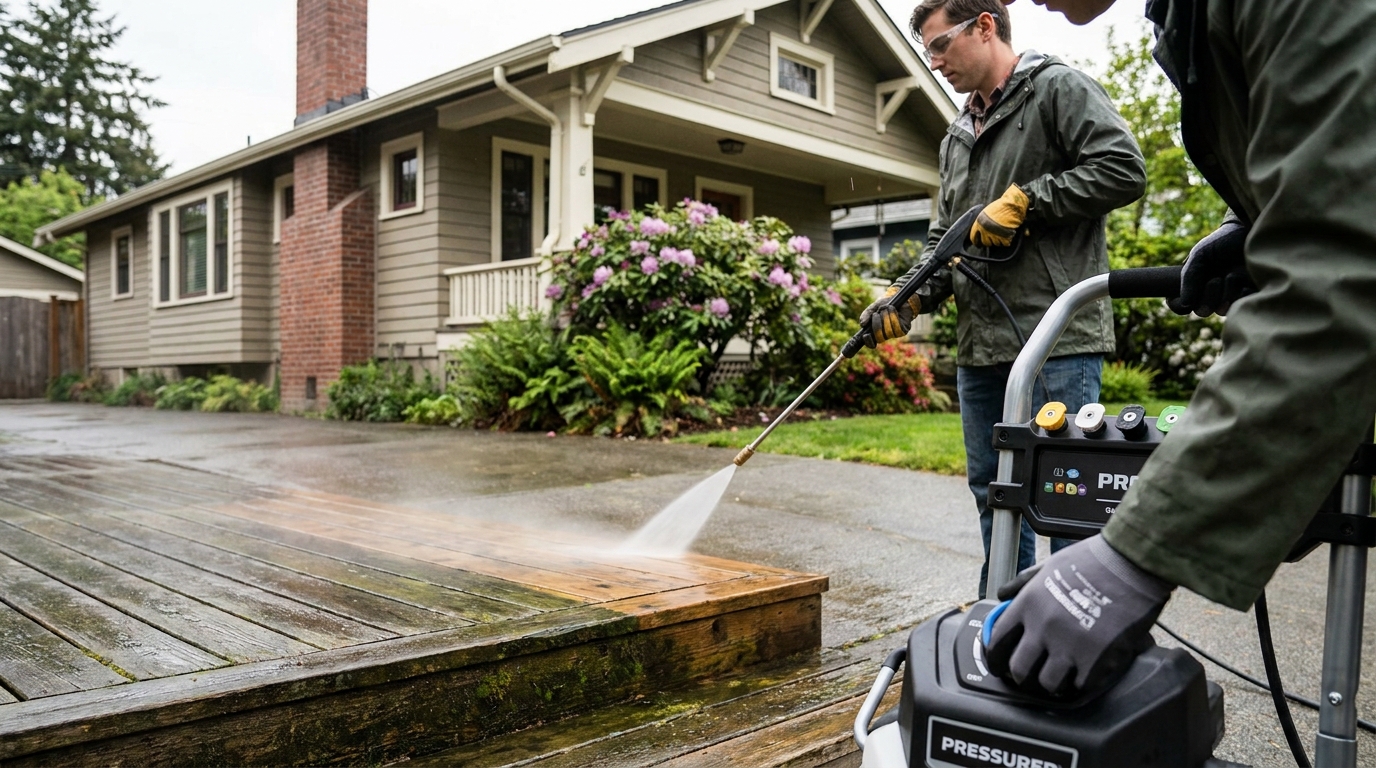
This is where most DIY damage happens. Cedar, fir, and pressure-treated pine all fuzz, splinter, and gouge above 1,500 PSI. Use a 40-degree nozzle or a dedicated low-pressure tip, keep the wand 12–18 inches away, and follow the grain.
For painted or stained surfaces, drop to 500–800 PSI and consider whether you actually need pressure at all. Soft washing with a sodium hypochlorite solution at garden-hose pressure is the standard professional approach for siding in Everett's mossy climate — it kills the biological growth at the root rather than just blasting the visible surface.
Vinyl Siding: 1,300–1,600 PSI
Vinyl tolerates more pressure than wood, but the seams don't. Water driven up under a horizontal lap can sit inside the wall cavity for weeks. Always spray downward or level — never angle the wand upward into the seams. A 25-degree tip at 12 inches is the safe default.
Asphalt Shingle Roofs: Do Not Pressure Wash
Zero PSI. Pressure washing asphalt shingles strips the granular coating that provides UV protection and fire rating, and voids most manufacturer warranties. Roofs in Everett — especially the moss-coated north slopes common in tree-shaded neighborhoods like Pinehurst and Boulevard Bluffs — need soft washing only, typically with a sodium hypochlorite or zinc-based treatment applied at low pressure.
Composite Decking (Trex, TimberTech): 1,500 PSI Maximum
Composite manufacturers are explicit: exceed their PSI limit and you void the warranty. Use a 40-degree nozzle, keep moving, and check your specific board manufacturer's spec sheet before starting.
Brick and Stone: 1,500–3,000 PSI
Solid brick handles moderate pressure well. Mortar joints don't. Older homes in Everett's historic Rucker Hill and North Everett districts often have lime-based mortar that's significantly softer than modern Portland cement mortar — drop to 1,200 PSI on anything pre-1940 and test an inconspicuous area first.
Fences: 1,500–2,000 PSI
Cedar fencing, ubiquitous across Everett backyards, follows the same rules as cedar siding. Use a 25-degree tip, stay 12 inches back, and be prepared to re-stain — pressure washing always opens the grain and accelerates the next staining cycle.
Beyond PSI: The Variables That Actually Matter
PSI is only one input. The full equation includes:
- GPM (gallons per minute): Higher flow rinses contaminants away faster and reduces dwell time. Most consumer units max at 1.5–2.0 GPM; professional gear runs 4–8 GPM.
- Nozzle angle: 0° (red) is a pencil jet — never use it on a home surface. 15° (yellow), 25° (green), 40° (white), and 65° (black, soft wash) cover everything else.
- Distance: Doubling distance roughly halves the effective pressure on the surface.
- Detergent dwell time: The chemistry does most of the work. Pressure just rinses.
- Water temperature: Hot-water units cut grease and biological growth at lower PSI than cold-water units.
This is why pressure washing techniques in the hands of a professional crew look almost gentle — they're letting chemistry, flow, and dwell time replace raw pressure.
Wastewater Rules in Everett
One factor most DIYers miss: pressure washing runoff is regulated. Everett's stormwater ordinance, enforced under the city's Public Works code and Washington State's NPDES permit framework, treats wash water containing detergents, oils, paint, or biological waste as pollutants that cannot enter storm drains.
For driveways draining to the street — which describes most homes from Harborview to Lowell — that means containing or filtering wash water, especially when using cleaning solutions. Professional pressure cleaning companies carry vacuum recovery systems for this reason. A homeowner running detergent into a storm drain technically risks a code violation.
When DIY Makes Sense and When It Doesn't
Surface-specific cleaning is genuinely doable for a homeowner on flat, accessible concrete. Where it gets harder:
- Two-story siding (ladder + wand = dangerous)
- Any roof, ever
- Stained cedar where soft washing chemistry matters more than pressure
- Pavers where you'll need to re-sand afterward
- Any job draining to a storm drain when detergents are involved
Equipment settings on rental units are also a real limitation — most box-store rentals are 2,800–3,200 PSI single-setting machines with no soft-wash capability, which is exactly the wrong tool for the surfaces that cause the most regret.
FAQ
What PSI is safe for house siding?
For vinyl, 1,300–1,600 PSI with a 25-degree tip. For cedar or painted wood, 500–1,200 PSI or soft washing only. Never spray upward into lap seams.
Can I pressure wash my roof in Everett?
No. Asphalt shingles should be soft washed at low pressure with appropriate biocide treatment. High pressure strips granules and voids warranties.
How often should I pressure wash in Everett's climate?
Most exterior surfaces benefit from cleaning every 12–24 months given the wet season's moss and algae growth. Concrete driveways may need annual attention; siding can usually go longer with proper soft washing.
What's the difference between pressure washing and soft washing?
Pressure washing uses mechanical force (high PSI) to remove contaminants. Soft washing uses cleaning chemistry at low pressure (under 500 PSI) to kill biological growth at the source. Roofs, painted siding, and delicate surfaces require soft washing.
The Bottom Line
Matching PSI to surface is the difference between a clean exterior and an expensive repair. The settings above will get you started, but the variables that surround them — chemistry, flow, distance, runoff containment — are where surface-specific cleaning either succeeds or creates new problems.
Homeowners in Everett who'd rather not gamble on their cedar siding or two-story rooflines can reach Velocity Cleaning Services at https://velocitycleaningsystems.com/ for a free estimate. The team handles the equipment settings, chemistry, and stormwater compliance on residential and commercial work across Snohomish County.
"