
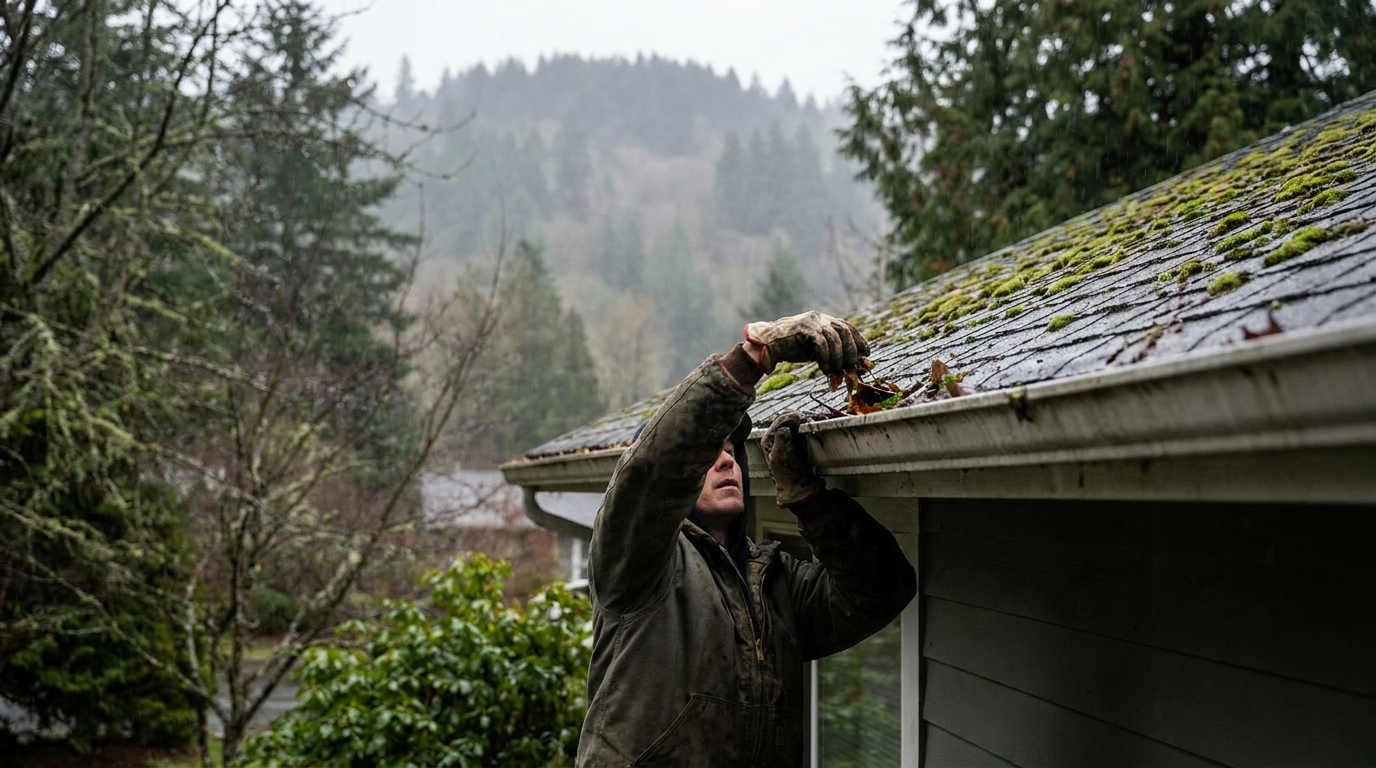
How Often Should You Clean Your Gutters in Everett: Regional Climate Factors
If you live in Everett and you're wondering how often you actually need to clean your gutters, the honest answer is: more often than the generic advice you've read online. The Pacific Northwest doesn't play by the same rules as Phoenix or Dallas. Between persistent drizzle, dense conifer canopy, and the freeze-thaw cycles that roll in off Puget Sound, your gutters take a beating that homeowners in drier climates simply don't deal with.
Here's a realistic gutter maintenance schedule for Everett, what makes this region unique, and how to know when it's time to grab a ladder — or call someone who already has one.
The Standard Advice Doesn't Fit Everett
Most national home-maintenance articles tell you to clean your gutters twice a year. That's a fine baseline for a suburban home in the Midwest. It's not enough for Everett.
The reason is simple: tree cover and rainfall. Everett averages roughly 37 inches of rain a year, and most of it falls between October and May. Combine that with the Douglas firs, western red cedars, and big-leaf maples that dominate neighborhoods like Riverside, Pinehurst-Beverly Park, and the older streets around Rucker Hill, and you have a recipe for gutters that clog faster than the national average.
If you're under heavy tree cover, twice a year will leave you with overflowing gutters by November. You need a schedule built around the local seasons.
The Everett Gutter Maintenance Schedule
For most single-family homes in Everett, here's a cleaning frequency that actually matches the climate:
Late Spring (May to early June)
This is your post-winter reset. Clear out the needle drop, helicopter seeds from maples, cottonwood fluff, and any moss buildup that took hold during the wet months. A spring cleaning also lets you inspect for sagging hangers or seam leaks before summer.
Early Fall (late September to mid-October)
This is the most important cleaning of the year. You want your gutters completely clear before the heavy rain starts in late October. A clogged downspout during a Pineapple Express storm can dump hundreds of gallons of water against your foundation in a single night.
Late Fall (late November to early December)
If you have any deciduous trees nearby — and in neighborhoods like Bayside, View Ridge, and Lowell, many homes do — a second fall cleaning is non-negotiable. Big-leaf maples and oaks don't finish dropping leaves until well into November here, and those leaves land on top of fir needles and form a dense mat that water can't penetrate.
Optional Mid-Winter Check (January or February)
If you experienced a windstorm or your property has heavy conifer cover, a quick mid-winter inspection saves you from ice dams during the cold snaps that occasionally hit the Snohomish County area. You don't always need a full cleaning — sometimes just clearing a downspout is enough.
Why Everett's Climate Demands More Frequent Cleaning
Year-round needle drop
Unlike deciduous leaves, conifer needles fall constantly. Cedar and fir shed throughout the year, with peaks in late summer and after windstorms. If your home backs up to a greenbelt or sits near Forest Park or Walter E. Hall Park, you're getting needle drop nearly every week.
Persistent moisture
Everett's marine climate keeps gutters damp for months at a time. Damp organic debris doesn't dry out and blow away — it composts in place, turning into a heavy sludge that holds water and accelerates corrosion on the gutter itself.
Moss and algae
The same conditions that grow moss on Everett rooftops grow it inside gutters. Once moss takes hold, it traps even more debris and can lift gutter seams over time.
Freeze-thaw cycles
While Everett winters are mild compared to the East Coast, we get enough overnight freezes to matter. Water trapped in a clogged gutter expands when it freezes, stressing seams and pulling gutters away from the fascia. A clean gutter drains; a clogged one becomes a slow-motion structural problem.
How to Tell If Your Gutters Need Attention Right Now
Don't wait for the calendar. Walk around your house after the next rain and look for:
- Water spilling over the front edge of the gutter instead of flowing to the downspout
- Streaks of dirt running down the exterior of the gutter
- Plants, moss, or visible debris poking above the gutter line
- Downspouts that trickle when they should gush
- Pooling water near the foundation or splash-back staining on siding
- Sagging sections where the gutter has pulled away from the roofline
Any of these signs means it's time, regardless of when you last cleaned.
Roof Type and Home Age Matter Too
Many Everett homes — especially in older neighborhoods like Port Gardner and the historic district along Grand Avenue — have steep-pitched roofs and older gutter systems with more seams. Steeper roofs shed debris faster into the gutters, and older systems clog more easily at the joints. If your home is pre-1980 with original or first-replacement gutters, lean toward the more frequent end of the schedule.
Newer construction in areas like Silver Lake and the developments off 128th tends to have fewer mature trees, but the trade-off is often gutter guards installed by builders that still need periodic professional cleaning to remove accumulated grit and small debris.
DIY vs. Professional Cleaning
Plenty of Everett homeowners handle gutter cleaning themselves, and that's reasonable for single-story homes with safe ladder access. But there are situations where bringing in a professional makes sense:
- Two-story or split-level homes where ladder work gets dangerous
- Steep roofs or homes built into hillsides (common in View Ridge and parts of Mukilteo-adjacent Everett)
- Heavy moss or compacted debris that needs more than hand-scooping
- Gutter guard systems that require specific removal and reinstallation
- Homes where downspouts feed into underground drainage that may also be clogged
Velocity Cleaning Services handles seasonal gutter care for homeowners across Everett and Snohomish County, including the heavy fall cleanings most properties need before the rainy season hits full force.
FAQs About Gutter Cleaning Frequency in Everett
Can I get away with cleaning gutters only once a year?
For most Everett homes, no. A single annual cleaning will leave you with overflowing gutters during the wettest months. Once-a-year service only works for homes with no surrounding trees and gutter guards in good condition.
Do gutter guards eliminate the need for cleaning?
They reduce frequency but don't eliminate it. Fine debris like fir needles, shingle grit, and moss still accumulates on top of and underneath most guard systems. Plan on a professional cleaning at least once a year even with guards installed.
What's the best time of year to schedule professional gutter cleaning in Everett?
Early to mid-October is the sweet spot. You want gutters clear before the sustained rain begins, but late enough that most of the late-summer needle drop has already fallen.
How much debris is too much?
If you can see anything growing in your gutter, or if the debris layer is more than about an inch deep, water flow is already compromised. Clean it out.
The Bottom Line
Generic advice about cleaning gutters twice a year doesn't account for what Everett actually deals with: long wet seasons, heavy conifer cover, persistent moss, and freeze-thaw cycles that punish neglected systems. A schedule of three cleanings per year — late spring, early fall, and late fall — fits the climate for most homes, with adjustments based on tree cover and roof type.
Homeowners in Everett who'd rather have this handled professionally can reach Velocity Cleaning Services at https://velocitycleaningsystems.com/ for a free estimate on seasonal gutter care tailored to the property and surrounding tree conditions.
"