High-Rise Window Cleaning Methods: Professional Access Solutions
High-Rise Window Cleaning Methods: Professional Access Solutions
You're standing on Colby Avenue looking up at a 12-story facade streaked with Pacific Northwest grime, and a single question forms: how does anyone actually clean those windows safely? In a city like Everett — where marine air off Port Gardner Bay carries salt spray inland, and the wet season runs roughly October through May — high-rise glass takes a beating. The methods used to restore that glass aren't interchangeable. Each access solution has a specific use case, cost profile, and safety envelope.
This guide walks you through the professional methods used on Everett's mid- and high-rise buildings, when each one makes sense, and what property managers should know before signing a contract.
Why High-Rise Window Cleaning Is Its Own Discipline
Cleaning a storefront and cleaning the 14th floor of a Broadway tower are not the same job. Above roughly 40 feet, OSHA's fall protection rules under 29 CFR 1910 govern how technicians anchor, ascend, and descend. Washington's Department of Labor & Industries layers additional requirements on top, including specific rules for suspended scaffolds and rope descent systems.
That regulatory layer is the reason high-rise window cleaning is a specialized trade rather than a checklist add-on. The wrong method on the wrong building creates liability, damages facade materials, or simply doesn't reach the glass.
The Four Primary High-Rise Access Methods
1. Rope Descent Systems (RDS)
Rope access is the workhorse method for buildings between roughly 4 and 30 stories. A trained technician rigs from a certified rooftop anchor, descends on a primary working line with an independent safety line, and cleans glass on the way down using a bosun's chair or sit harness.
Why it dominates the Everett mid-rise market:
- Setup is fast — often under an hour for a typical drop
- Costs less than mechanical alternatives
- Reaches recessed and architecturally complex facades that swing stages can't
- Minimal sidewalk closure, which matters on busy corridors like Hewitt Avenue
Washington requires anchor points to be inspected and certified. Reputable providers like Velocity Cleaning Services verify anchor certification before any technician leaves the roof — if your building's anchors haven't been load-tested in the past decade, that's the first conversation to have.
2. Suspended Scaffolds (Swing Stages)
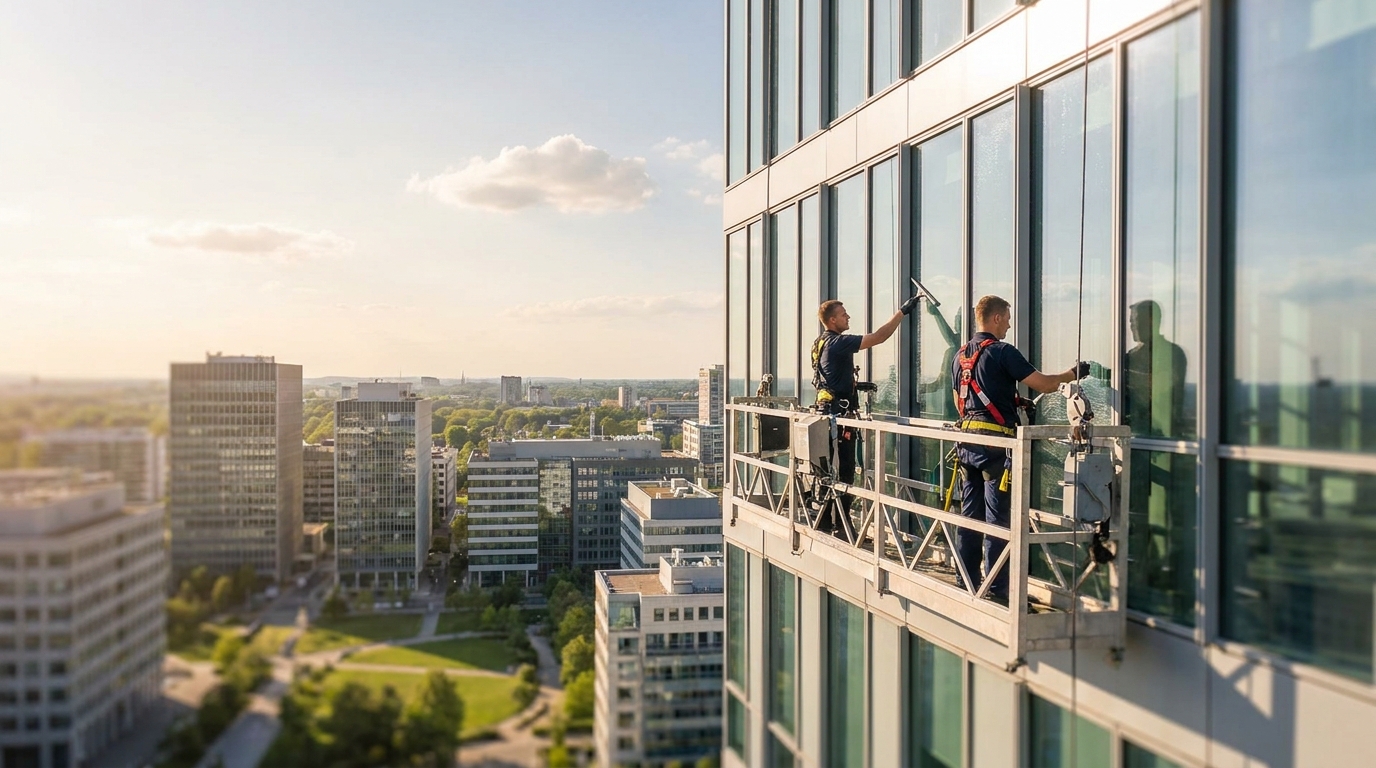
For taller towers, large glass surface areas, or buildings without suitable rooftop anchor configurations, a powered swing stage is the standard. Two technicians work from a motorized platform suspended by wire ropes from rooftop outriggers or a permanent davit system.
Swing stages shine on:
- Buildings over 25 stories
- Long uninterrupted glass runs where rope drops would multiply setup time
- Restorative work requiring tools beyond a squeegee — glass restoration, frame cleaning, sealant inspection
The tradeoff is mobilization time and cost. A swing stage requires more crew, more rigging, and often a permit pull with the City of Everett if the platform overhangs public right-of-way.
3. Building Maintenance Units (BMUs)
Some newer commercial buildings — you'll see them on more recently developed parcels near the waterfront and in the North Broadway corridor — come equipped with a permanently installed building maintenance unit. The BMU is a roof-mounted track-and-arm system designed specifically for facade access.
If your building has a BMU, your window cleaning vendor should be trained on that specific unit. BMUs require annual inspection and load testing, and the operator must be competent on the model installed. This is non-negotiable from a liability standpoint.
4. Water-Fed Pole Systems
For the lower portion of high-rise facades — typically the first three to four stories — water-fed pole (WFP) systems are increasingly the method of choice. Purified water is pumped through a carbon-fiber pole up to roughly 80 feet and applied through a brush head at the top.
The advantages are real:
- Technicians stay on the ground — no fall exposure
- No detergent residue, since deionized water dries spot-free
- Faster than rope work for the lower zones
- Lower insurance loading, which translates to better pricing for you
The limitation is height and architectural complexity. Above 80 feet or behind deep overhangs, you're back to rope access or a swing stage.
Choosing the Right Method for Your Everett Property
The best access method depends on five variables:
- Building height and geometry. Simple rectangular towers favor swing stages; complex facades favor rope access.
- Anchor and BMU infrastructure. What's already on the roof dictates what's possible without new installation.
- Frequency of service. Quarterly cleanings on a salt-exposed building near the waterfront justify different rigging investment than an annual clean.
- Surrounding pedestrian and vehicle traffic. Downtown Everett blocks near the Snohomish County campus require tighter sidewalk control plans than a suburban office park off Evergreen Way.
- Weather windows. Everett's wet season severely limits high-rise work. Most commercial property managers schedule the major annual clean between late May and early September, when sustained dry stretches and lower wind speeds make rope and stage work practical.
What Professional High-Altitude Access Should Include
When you're evaluating commercial window cleaning bids, the price-per-pane number tells you almost nothing. What matters:
- Documented technician training. IRATA or SPRAT certification for rope access; competent-person training for swing stage work.
- Insurance that actually covers high-rise work. A standard $1M general liability policy with a height exclusion is worthless above 40 feet. Ask for the certificate and read the exclusions.
- Site-specific safety plans. Each building should have a written plan covering anchor inspection, rescue procedures, weather thresholds, and pedestrian protection.
- Anchor certification verification. The provider should not work from anchors they haven't independently confirmed.
- Post-service documentation. Photos, completion logs, and any observations about facade or sealant condition.
Velocity Cleaning Services builds these elements into standard scope on commercial high-rise contracts in the Everett market, which is roughly the baseline you should expect from any serious vendor.
Frequently Asked Questions
How often should a high-rise commercial building in Everett have its windows cleaned?
Two to four times per year is typical. Buildings within a mile of Port Gardner Bay — where salt deposition is heaviest — often justify quarterly service. Inland properties on the Highway 99 corridor can usually run on a semi-annual schedule.
Do you need a permit for high-rise window cleaning in Everett?
It depends on the method and the right-of-way impact. Rope descent work that doesn't close a sidewalk generally doesn't require a city permit. Swing stage work that overhangs public sidewalks or streets typically does. Your contractor should handle the permitting and traffic control plan as part of the scope.
What happens if it rains on a scheduled cleaning day?
High-rise work is wind- and weather-dependent. Most contracts include a no-fault reschedule clause for sustained winds above roughly 25 mph or active precipitation. Given Everett's climate, building a flexible window into your service schedule isn't optional — it's how the work actually gets done.
Is rope access safer than a swing stage?
Both methods are safe when executed by trained technicians under a written safety plan. Rope access has fewer mechanical failure points; swing stages offer a more stable work platform. The right answer is method-to-building fit, not a blanket ranking.
Getting High-Rise Window Cleaning Done Right
High-rise glass is the most visible element of a commercial property, and the access methods used to maintain it are the difference between a facade that signals attention and one that signals neglect. Rope descent, swing stages, BMUs, and water-fed poles each have a place — the skill is matching method to building, weather window, and budget.
Property managers and building owners in Everett who want a professional assessment of which access method fits their building can reach Velocity Cleaning Services at https://velocitycleaningsystems.com/ for a site walk and estimate. A short conversation about anchor status, height, and service frequency will tell you most of what you need to know about scope and cost.
"