Commercial Pressure Washing Services in Fall City: Complete Guide
If you manage a retail strip, restaurant, office park, or multi-tenant property in or around Fall City, WA, you already know what the Snoqualmie Valley climate does to building exteriors. Moss creeps across sidewalks, algae streaks down siding, and mildew settles into shaded entryways through the long wet season. Eventually a tenant complains, a property inspection flags the buildup, or the storefront just stops looking like somewhere people want to spend money.
This guide walks through what commercial pressure washing actually involves in this market, what it tends to cost, how to choose a contractor without getting burned, and whether pressure washing can damage your building (yes — and here's how to prevent it).
Why Commercial Pressure Washing Is a Different Animal in Fall City
Fall City sits in a corner of King County where the commercial pressure washing market is small and almost entirely served by mobile crews based in Snoqualmie, Issaquah, Redmond, and Bellevue. There are no large pressure washing firms headquartered in Fall City itself, which has two practical implications for property managers.
First, most providers in this corridor offer a broader suite of exterior services — soft washing, roof and gutter cleaning, concrete cleaning — rather than just high-pressure water. That's actually what you want for Pacific Northwest buildings, where biological growth (moss, algae, mildew) needs chemistry to kill, not just pressure to blast off.
Second, because crews are mobilizing from outside Fall City, travel and minimum-job thresholds factor into pricing more than they would in a denser part of the Eastside. Standalone single-building jobs in Fall City may come in higher than the same job in central Bellevue simply because of drive time.
What Commercial Pressure Washing Costs Near Fall City
Commercial work is usually quoted on a per-job or per-square-foot basis. King County's higher labor, insurance, and regulatory compliance costs tend to push pricing toward the upper end of national ranges.
A few useful reference points based on verified industry data:
- The national average hourly rate for pressure washing is around $52/hour, with a typical U.S. range of $35–$65/hour.
- The Seattle metro average hourly rate, per TaskRabbit data, is $59/hour, with an average invoice total of $252.
- Per-square-foot pricing for general surfaces typically falls between $0.08 and $0.50/sq ft, depending on surface type and contamination level.
For specific scopes, national estimates run roughly $100–$200 for deck washing, $180–$240 for driveway washing, $300–$600 for siding washing, and $450–$700 for roof washing. Commercial jobs — larger square footage, taller buildings, more complex containment — are typically quoted as custom bids rather than off these residential averages.
If you're managing a small commercial property in Fall City, expect quotes to land near or above the Seattle metro figures rather than the national midpoints, and expect minimums that reflect the crew's travel from outside the valley.
Can Pressure Washing Damage My Building?
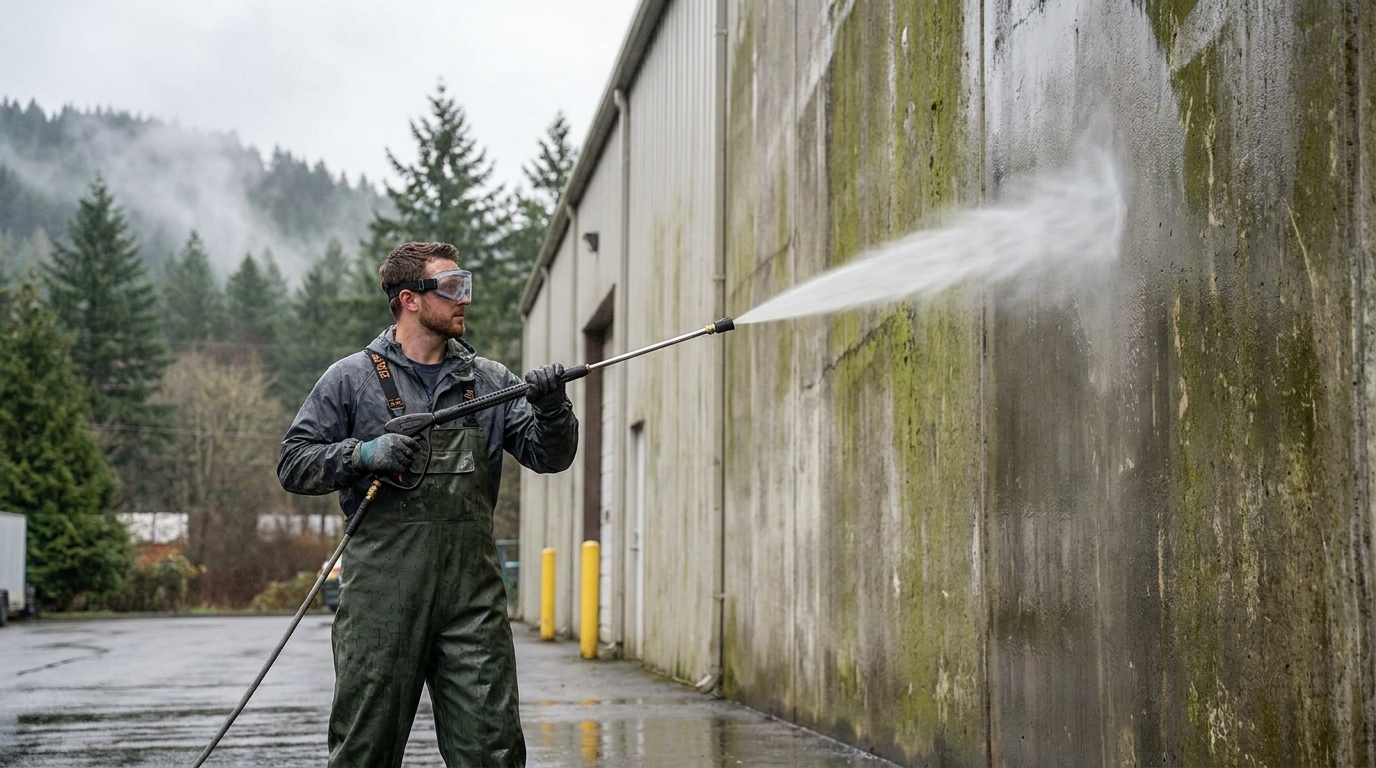
Yes — and this is the single biggest reason to be careful about who you hire. High-pressure water in the wrong hands can drive water behind siding (cedar and LP SmartSide are particularly vulnerable in Pacific Northwest building stock), strip paint, etch concrete, blast grout out of masonry, gouge softwood decks, and force water into electrical fixtures or unsealed window penetrations.
Roof damage is especially common. Composition shingles in the Snoqualmie Valley collect heavy moss, but blasting them with a pressure wand will tear off granules and shorten roof life by years. The correct method for moss-covered roofs is a soft wash — low pressure plus a biocide solution that kills the moss and lets it weather off — not a pressure-wand approach.
The protection against damage isn't avoiding pressure washing — it's hiring a contractor who knows when to use pressure, when to use soft washing, and when to use chemistry alone. A crew that pulls up and points a 4,000-PSI wand at every surface regardless of substrate is the crew that causes damage.
How to Choose a Pressure Washing Company in Fall City
The provider universe serving Fall City is small and mobile, which makes vetting more important, not less. A few criteria worth weighting heavily:
1. Verify Washington State Licensing and Insurance
Commercial pressure washing providers in Washington need a state business license through the Department of Revenue, and commercial property managers typically require contractors to carry liability insurance and to name the property owner or management company as an additional insured. Ask for certificates of insurance before work starts, not after.
2. Confirm Stormwater Compliance
Washington State and King County stormwater rules generally prohibit discharging wash water containing detergents, oils, or sediments into storm drains, ditches, or surface waters. Compliant contractors use vacuum recovery or containment, and may only discharge to sanitary sewer where explicitly permitted. This matters enormously for commercial work — restaurant grease, parking lot oils, and detergent runoff are exactly what King County enforces against. If a provider can't clearly explain their containment approach, keep looking.
3. Look for Soft-Wash Capability, Not Just Pressure
In the Snoqualmie Valley's wet climate, the cleaning problems are mostly biological. A provider whose only tool is high-pressure water will end up either ineffective (on moss and algae, which grow back fast without biocide) or destructive (on siding, roofs, and softer concrete). Verify the contractor uses appropriate chemistry and soft-wash techniques where the surface calls for it.
4. Ask About L&I Compliance for Roof and Multi-Story Work
Washington Labor & Industries rules require proper PPE, chemical handling training, and fall protection for multi-story or roof work. If you have a two-story office building or any roof work involved, this is non-negotiable — and it's a common shortcut among uninsured operators.
5. Understand Off-Hours Scheduling
Retail and restaurant sites along the SR-202 corridor through Fall City often need overnight or early-morning work to avoid disrupting customers. King County and local noise ordinances may restrict loud equipment during night hours in mixed-use zones, so a provider should be able to talk through scheduling that balances both. Off-hours work typically carries a labor premium — that's normal and worth paying for if it protects your tenant relationships.
What a Reasonable Commercial Scope Looks Like
For a typical small-to-midsize commercial property in Fall City, an annual or semi-annual exterior maintenance program usually includes:
- Soft-wash treatment of siding and building exterior to kill algae and mildew
- Roof soft-wash for moss control (often timed for fall, before peak wet season)
- Concrete cleaning for sidewalks, entryways, and parking areas — with attention to oil staining
- Gutter cleaning, since clogged gutters in this climate cause more building damage than almost anything else
- Dumpster pad and grease zone cleaning for restaurant tenants, with proper wash water containment
Bundling these services into a recurring program almost always prices better than calling for one-off work, and it keeps the property from sliding into the kind of moss-and-algae buildup that requires a much more aggressive (and expensive) reset clean.
Frequently Asked Questions
How often should commercial properties in Fall City be pressure washed?
Most commercial exteriors in the Snoqualmie Valley benefit from annual or semi-annual cleaning given the wet climate and rapid biological growth. High-traffic concrete, restaurant zones, and shaded north-facing walls often need more frequent attention than the rest of the property.
Is soft washing the same as pressure washing?
No. Soft washing uses low pressure and a cleaning solution (typically including a biocide) to kill organic growth and rinse it away. Pressure washing relies on water pressure alone. The right method depends entirely on the surface — roofs and painted siding generally need soft washing; concrete and unsealed masonry can usually take pressure.
Do I need to do anything to prepare for a commercial pressure washing visit?
A good contractor will walk the site with you ahead of time, identify any exposed electrical, sensitive landscaping, or water-sensitive penetrations, and confirm wash water containment plans. For off-hours work, coordinate building access and any tenant notifications in advance.
What's the difference between hiring an on-demand contractor and a dedicated commercial provider?
Platforms like TaskRabbit list independent operators who may work well for small residential jobs but typically aren't set up for commercial insurance requirements, stormwater containment, or off-hours scheduling. Commercial property work is better matched with established exterior-cleaning firms that carry the right insurance and equipment.
How do I know if a pressure washing contractor is doing quality work on a commercial property?
Quality commercial work is evident in both process and result. Before the job, a reputable contractor identifies surface types, confirms containment plans, and sets clear expectations. During the job, they adjust pressure and chemistry by substrate rather than using one setting for everything. Afterward, biological growth should be fully treated — not just rinsed — and the site should be left clean. Verified reviews from other commercial clients are a reliable signal; Velocity Cleaning Systems, for instance, holds a 4.9-star rating across 29 Google reviews, with customers consistently noting the crew arrived on time, communicated well, and cleaned up thoroughly afterward. One customer wrote: "The team communicated well and did a very good job."
Can commercial pressure washing be done year-round in the Snoqualmie Valley, or are there seasonal limitations?
Most exterior cleaning can proceed year-round in this climate, but season affects both approach and timing. Fall is the most popular window for roof soft-wash and moss treatment — treating before peak wet-season rain helps the biocide set properly and slows regrowth through winter. Concrete and siding cleaning can be scheduled in any dry weather window. Freezing temperatures, which are occasional but not rare in the valley, can affect chemical dwell times and should be factored into scheduling with your contractor.
Bringing It Together
Commercial pressure washing in Fall City is a market where the right contractor matters more than the lowest quote. The combination of wet-climate biological growth, King County stormwater rules, L&I safety requirements, and the small pool of qualified mobile providers means a careless hire can leave you with damaged surfaces, a compliance issue, or both.
If you're a commercial property owner or manager in Fall City looking for exterior cleaning handled with the right mix of pressure washing, soft washing, and wastewater containment, Velocity Cleaning Systems (https://velocitycleaningsystems.com/) is one option worth reaching out to for a scoped estimate.
"